
On this page
In this post
- Infinitives, stems and endings: how a verb is built
- Regular and irregular verbs, in one picture
- The 100 most common verbs, in order of frequency
- Where Spanish verbs don't work like English
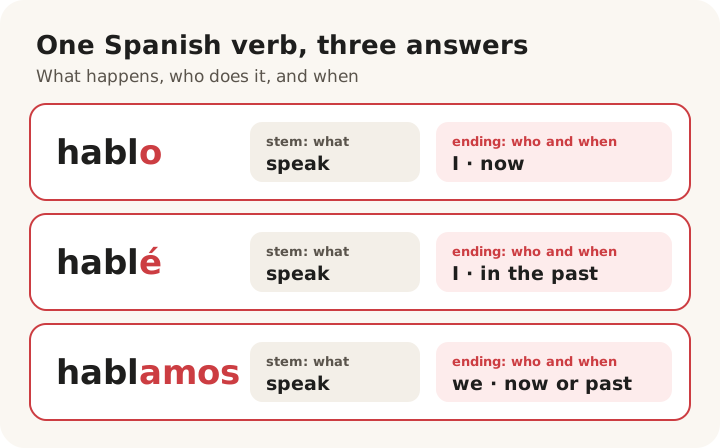
Spanish verbs pack a whole sentence into one word. Take hablo. The stem habl- means “speak,” and the ending -o says two more things: the speaker is “I,” and it’s happening now. So hablo is “I speak,” no pronoun needed. Learn how that ending works, and the rest of the system starts to make sense.
How Spanish verbs work: infinitives, stems and endings
Every verb has a dictionary form, the infinitive. It matches the English “to” form: hablar is “to speak.” Infinitives in Spanish end in one of three ways, and that ending puts the verb in its group: -ar (hablar, to speak), -er (comer, to eat) or -ir (vivir, to live).
To use a verb in a sentence, you conjugate it. Take off the -ar, -er or -ir to get the stem (habl-, com-, viv-), then add the ending that matches the person and the tense.
Here’s the present tense for one verb of each group. It’s the only full table on this page; each group has its own lesson with every tense.
| Person | hablar (-ar) | comer (-er) | vivir (-ir) |
|---|---|---|---|
| yo | hablo | como | vivo |
| tú | hablas | comes | vives |
| él, ella, usted | habla | come | vive |
| nosotros | hablamos | comemos | vivimos |
| ellos, ellas, ustedes | hablan | comen | viven |
Because the ending already says who, Spanish usually drops the subject pronoun. Hablo inglés is a complete sentence. Adding yo (yo hablo inglés) puts weight on it: “I speak English.”
Usted habla muy bien español.
You speak Spanish very well.
¿Tú comes carne?
Do you eat meat?
Nosotros vivimos en Lima.
We live in Lima.
For every -ar ending in four tenses, with 50 verbs to practice on, see -ar Spanish verbs.
Who you’re talking to: tú, usted, ustedes (and vos, vosotros)
English has one “you.” Spanish has several, and the verb changes with each one:
- tú is the friendly “you” for one person: tú hablas.
- usted is the polite “you,” conjugated like él: usted habla.
- ustedes is “you all,” for any group, conjugated like ellos: ustedes hablan. That’s the plural in all of Latin America.
- vos replaces tú in Argentina, Uruguay and much of Central America: vos hablás.
- vosotros is “you all” in Spain only: vosotros habláis.

If you’re learning for the US, Mexico or Colombia, focus on tú, usted and ustedes. Learn to recognize the other two.
Regular vs. irregular verbs: what’s the difference
A regular verb follows its group’s model in every tense: learn hablar and you can conjugate trabajar, estudiar and hundreds more. An irregular verb breaks the model somewhere, usually in one of three ways.
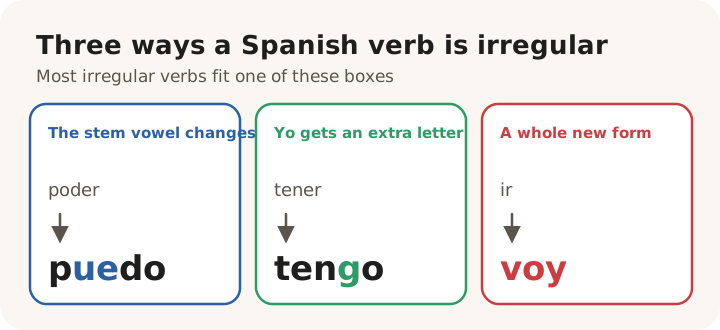
- The stem vowel changes in some forms: poder → puedo, pensar → pienso, pedir → pido. These follow a fixed pattern, the “boot,” explained in Spanish stem changing verbs.
- The yo form picks up a letter: tener → tengo, conocer → conozco. These and the truly irregular verbs are grouped by pattern in Spanish irregular verbs.
- The verb changes almost completely: ir → voy, ser → soy.
One thing that looks irregular and isn’t: busqué, llegué, empecé. That’s a spelling change to keep the sound, covered in car, gar, zar verbs.
The 100 most common Spanish verbs (a Spanish verbs list you can use)
Here are the 100 most common Spanish verbs, in order of how often they appear in real Spanish. The order comes from Verbos.app, Los 100 verbos más usados en español, which builds it from frequency dictionaries of written and spoken Spanish. Every linked verb opens its own page, with audio for every form, the irregular forms in red, three example sentences and a short practice drill. The “type” column comes from our conjugator’s own irregularity marks.
The top 10: the basic Spanish verbs
These are the basic Spanish verbs you’ll hear in every conversation, and all ten are irregular. That’s not bad luck. The more often a verb is used, the longer it keeps its old irregular forms; researchers measured exactly that across a thousand years of English verbs (Lieberman and colleagues, Nature, 2007).
| # | Verb | Meaning | Type |
|---|---|---|---|
| 1 | ser | to be | irregular |
| 2 | estar | to be (location, state) | irregular |
| 3 | haber | to have (auxiliary), there is | irregular |
| 4 | tener | to have | irregular |
| 5 | hacer | to do, to make | irregular |
| 6 | poder | can, to be able to | irregular |
| 7 | decir | to say, to tell | irregular |
| 8 | ir | to go | irregular |
| 9 | ver | to see, to watch | irregular |
| 10 | dar | to give | irregular |
Soy de Chicago, ¿y tú?
I'm from Chicago. And you?
La comida está lista.
The food is ready.
Había mucha gente en la fiesta.
There were a lot of people at the party.
¿Tienes hambre?
Are you hungry?
¿Qué haces el fin de semana?
What do you do on the weekend?
No pude dormir anoche.
I couldn't sleep last night.
Me dijo que venía.
He told me he was coming.
De niño, iba a pie al colegio.
As a kid, I used to walk to school.
De niña, veía dibujos animados todas las tardes.
As a girl, I watched cartoons every afternoon.
Me dio un abrazo.
He gave me a hug.
Verbs 11 to 40
| # | Verb | Meaning | Type |
|---|---|---|---|
| 11 | saber | to know (facts), to know how to | irregular |
| 12 | querer | to want, to love | irregular |
| 13 | llegar | to arrive, to get (somewhere) | spelling change |
| 14 | pasar | to pass, to happen, to spend (time) | regular |
| 15 | deber | must, should, to owe | regular |
| 16 | poner | to put, to place, to turn on | irregular |
| 17 | parecer | to seem, to look like | irregular |
| 18 | quedar | to stay, to remain, to meet up | regular |
| 19 | creer | to believe, to think | spelling change |
| 20 | hablar | to speak, to talk | regular |
| 21 | llevar | to take, to carry, to wear | regular |
| 22 | dejar | to leave, to let, to quit | regular |
| 23 | seguir | to follow, to keep (doing) | stem change |
| 24 | encontrar | to find, to meet | stem change |
| 25 | llamar | to call | regular |
| 26 | venir | to come | irregular |
| 27 | pensar | to think | stem change |
| 28 | salir | to go out, to leave | irregular |
| 29 | volver | to come back, to return | stem change |
| 30 | tomar | to take, to drink | regular |
| 31 | conocer | to know (people, places), to meet | irregular |
| 32 | vivir | to live | regular |
| 33 | sentir | to feel, to be sorry | stem change |
| 34 | tratar | to treat, to try | regular |
| 35 | mirar | to look at, to watch | regular |
| 36 | contar | to count, to tell | stem change |
| 37 | empezar | to start, to begin | stem change |
| 38 | esperar | to wait, to hope, to expect | regular |
| 39 | buscar | to look for, to search | spelling change |
| 40 | existir | to exist | regular |
Verbs 41 to 100
| # | Verb | Meaning | Type |
|---|---|---|---|
| 41 | entrar | to go in, to come in, to enter | regular |
| 42 | trabajar | to work | regular |
| 43 | escribir | to write | irregular participle |
| 44 | perder | to lose, to miss | stem change |
| 45 | producir | to produce | irregular |
| 46 | ocurrir | to happen, to occur | regular |
| 47 | entender | to understand | stem change |
| 48 | pedir | to ask for, to order (food) | stem change |
| 49 | recibir | to receive, to get | regular |
| 50 | recordar | to remember, to remind | stem change |
| 51 | terminar | to finish, to end | regular |
| 52 | permitir | to allow, to let | regular |
| 53 | aparecer | to appear, to show up | irregular |
| 54 | conseguir | to get, to manage to | stem change |
| 55 | comenzar | to begin, to start | stem change |
| 56 | servir | to serve, to be useful | stem change |
| 57 | sacar | to take out, to get | spelling change |
| 58 | necesitar | to need | regular |
| 59 | mantener | to keep, to maintain, to support | irregular |
| 60 | resultar | to turn out, to result | regular |
| 61 | leer | to read | spelling change |
| 62 | caer | to fall | irregular |
| 63 | cambiar | to change, to exchange | regular |
| 64 | presentar | to present, to introduce | regular |
| 65 | crear | to create | regular |
| 66 | abrir | to open | irregular participle |
| 67 | considerar | to consider | regular |
| 68 | oír | to hear | irregular |
| 69 | acabar | to finish, to have just | regular |
| 70 | convertir | to turn into, to convert | stem change |
| 71 | ganar | to win, to earn | regular |
| 72 | formar | to form, to train | regular |
| 73 | traer | to bring | irregular |
| 74 | partir | to split, to cut, to leave | regular |
| 75 | morir | to die | stem change |
| 76 | aceptar | to accept | regular |
| 77 | realizar | to carry out, to do, to make happen | spelling change |
| 78 | suponer | to suppose, to mean | irregular |
| 79 | comprender | to understand | regular |
| 80 | lograr | to achieve, to manage to | regular |
| 81 | explicar | to explain | spelling change |
| 82 | preguntar | to ask | regular |
| 83 | tocar | to touch, to play (an instrument) | spelling change |
| 84 | reconocer | to recognize, to admit | irregular |
| 85 | estudiar | to study | regular |
| 86 | alcanzar | to reach, to catch up with | spelling change |
| 87 | nacer | to be born | irregular |
| 88 | dirigir | to direct, to lead, to manage | spelling change |
| 89 | correr | to run | regular |
| 90 | utilizar | to use | spelling change |
| 91 | pagar | to pay | spelling change |
| 92 | comer | to eat | regular |
| 93 | gustar | to be pleasing (me gusta) | regular |
| 94 | jugar | to play (a game, a sport) | stem change |
| 95 | dormir | to sleep | stem change |
| 96 | aprender | to learn | regular |
| 97 | comprar | to buy | regular |
| 98 | escuchar | to listen to, to hear | regular |
| 99 | ayudar | to help | regular |
| 100 | usar | to use, to wear | regular |
Verbs without a link are in the conjugator too; we’ll link them here as their pages join our index. And if you want this Spanish verbs list on paper, the printable verb tables cover 50 of these verbs in six tenses.
The tenses you’ll meet first
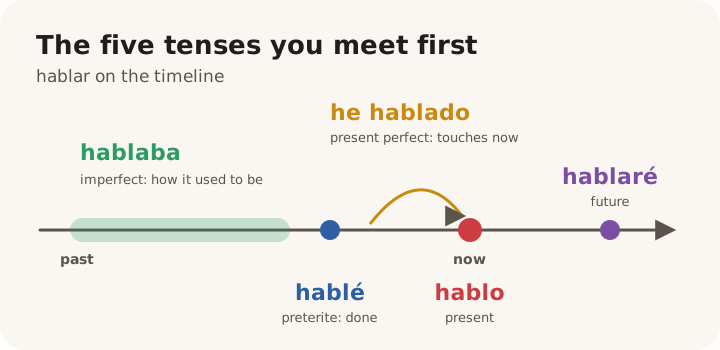
Spanish has more tenses than you need on day one. These five cover most everyday conversation. Here’s hablar in each:
| Tense | hablar (yo) | Use it for |
|---|---|---|
| Present | hablo | now, habits, the near future |
| Preterite | hablé | finished actions in the past |
| Imperfect | hablaba | how things were, what used to happen |
| Future | hablaré | plans and predictions |
| Present perfect | he hablado | the past that touches now |
Hoy hablo con mi jefe.
Today I'm talking to my boss.
Ayer hablé con mi mamá.
Yesterday I talked to my mom.
Mi abuelo hablaba cinco idiomas.
My grandfather spoke five languages.
Mañana hablaré con el profesor.
Tomorrow I'll talk to the teacher.
Esta semana he hablado mucho.
I've talked a lot this week.
The two past tenses are the ones that take time to sort out. Start with Spanish past tense, then go deeper with the preterite, the imperfect and preterite vs. imperfect. The preterite also has its own set of irregular stems (tuve, hice, dije), listed in irregular preterite verbs.
Spanish verbs that don’t work like English
Some of the hardest Spanish verbs for English speakers aren’t hard to conjugate. They’re hard because English sends you the wrong way.

- “To be” is two verbs. Ser for what something is (soy profesora), estar for where it is and how it is right now (estoy cansada). The full comparison is in ser vs. estar.
- “To know” is two verbs too. Saber is knowing a fact or how to do something (sé nadar); conocer is knowing a person or a place (conozco a tu hermana). See saber and conocer.
- “I like” works backwards. Me gusta la música is literally “music pleases me,” so the verb agrees with the thing you like: me gustan las montañas. Explained in gustar and verbs like gustar.
- Hunger and age use tener. “I’m hungry” is tengo hambre (I have hunger), and “I’m 20” is tengo 20 años.
- No “do” in questions and negatives. ¿Hablas español? / No hablo francés.
- The present covers “-ing.” ¿Qué haces? can mean “What are you doing?”
- The second verb stays in the infinitive. Quiero comer (I want to eat), puedo ir (I can go), necesito estudiar (I need to study). That’s the other everyday job of infinitives in Spanish: after another verb, they work like the English “to” form.
- Some verbs come with me, te, se. Me levanto a las siete (I get up at seven). These are reflexive verbs, and the me is part of the verb.
How to learn Spanish verbs without drowning in charts
Charts are useful, but nobody learns to speak from them. Here’s what I ask my students to do instead:
- Go by frequency. Learn the verbs in the order of the list above. The first 20 show up in almost every conversation.
- Start with yo, tú and él. Those three forms carry most of what you’ll say and hear. Nosotros and ellos come fast after that.
- Sentence before table. Tengo dos hermanos teaches you tener better than six rows of forms. Every linked verb page has three example sentences with audio: listen, repeat, then read the table.
- One verb a day. Open one verb page, listen to every form, and do the practice drill at the bottom. Five minutes, and tomorrow you start with the next one.
Try a quick check of what’s on this page:
Spanish verbs: quick check
0 of 8Nosotros ___ en Chicago. (vivir)
Ellos ___ mucho. (trabajar)
Yo ___ cansada hoy. (to be)
Yo ___ veinte años. (to be 20)
Me ___ los libros. (gustar)
Quiero ___ algo. (comer)
¿___ inglés? (Do you speak)
Ustedes ___ muy rápido. (hablar)
Frequently asked questions
Which common Spanish verbs should I learn first?
The top 10 on the list: ser, estar, haber, tener, hacer, poder, decir, ir, ver and dar. Then saber, querer, llegar, pasar and poner. With those 15 common Spanish verbs you can already say a lot about yourself, your plans and your day.
What are the “super 7” verbs in Spanish?
It’s a classroom list, not an official one. The idea comes from comprehensible input teaching, where it’s usually credited to the teacher Terry Waltz: es, está, tiene, hay, va, le gusta and quiere. Lists vary by teacher, but they all overlap with the basic Spanish verbs at the top of our frequency list.
What are the three types of verbs in Spanish?
By ending: -ar, -er and -ir. That’s the group that decides the endings. Separately, any verb can be regular or irregular.
Do I need to learn vosotros?
Only if you’re learning Spanish for Spain. In Latin America, ustedes is the plural “you” everywhere, so you can treat vosotros as something to recognize when you hear it.
Where to go next
Pick the row that sounds like you:
| If you want to… | Go to |
|---|---|
| see any verb conjugated, with audio for every form | Spanish conjugator (all 710 verbs, A to Z) |
| practice right now, with instant correction | conjugation trainer |
| start with the -ar group | -ar Spanish verbs |
| sort out the irregular ones | Spanish irregular verbs |
| understand the boot (pienso, puedo, pido) | Spanish stem changing verbs |
| talk about the past | Spanish past tense |
| drill sentences with audio | regular verbs practice and irregular verbs practice |
| stop mixing up ser and estar | ser vs. estar |

Spanish teacher · B.A. in Spanish (UnB) · 10+ years teaching
Spanish teacher with a degree in Spanish from the University of Brasília (UnB) and more than 10 years teaching.


