
On this page
In this post
- Why it's me gusta and never yo gusto
- Me gusta or me gustan, and a mí también
- 15 Spanish verbs like gustar, grouped by meaning
- A quiz that tells you why
Gustar and verbs like gustar work backwards compared to English. Me gusta el café doesn’t really say “I like coffee.” Word for word, it says “coffee pleases me”: the coffee is the subject, and you’re on the receiving end.
Me gusta el café.
I like coffee. (Coffee pleases me.)
Me gustan los perros.
I like dogs. (Dogs please me.)
Get that one flip right and the rest falls into place: gusta or gustan, the little pronoun in front, and the fifteen other verbs that are built the same way.
How gustar and verbs like gustar work
Gustar in English is closer to “to please” than to “to like.” English puts the person first (I like coffee). Spanish puts the thing first, as the subject, and the person comes in as an indirect object pronoun: me, te, le.

So what is gustar in English, really? “To please.” That’s why yo gusto el café isn’t Spanish: yo gusto means “I am pleasing” (to someone), and in me gusta el café the one doing the pleasing is the coffee.
The pronouns: me, te, le, nos, os, les
Gustar verbs always take one of these pronouns, right before the verb:
| Who likes it | Pronoun | Example | English |
|---|---|---|---|
| I | me | Me gusta el mar. | I like the ocean. |
| you (tú, vos) | te | ¿Te gusta el mar? | Do you like the ocean? |
| he, she, you (usted) | le | Le gusta el mar. | He likes the ocean. |
| we | nos | Nos gusta el mar. | We like the ocean. |
| you all (Spain only) | os | ¿Os gusta el mar? | Do you all like the ocean? |
| they, you all (ustedes) | les | Les gusta el mar. | They like the ocean. |
In Latin America, ustedes covers “you all,” so you’ll use les: ¿A ustedes les gusta la comida mexicana? More practice with these pronouns is in the pronoun exercises.
A mí, a ti, a Juan: adding the person
Le gusta could be him, her or you. To make it clear, or just to add emphasis, add a + the person: a Juan le gusta el fútbol, a mis padres les gusta la playa, a mí me encanta. The pronoun stays even when you add the name. A Juan gusta el fútbol is missing a piece.
A Juan le gusta el fútbol.
Juan likes soccer.
A mis padres les gusta la playa.
My parents like the beach.
Me gusta or me gustan? Look at the thing, not the person
The verb only has to match the thing you like. One thing, or an activity: gusta. Two or more things: gustan. Who likes it doesn’t change the verb at all: me gusta, nos gusta, les gusta.
Me gusta el chocolate.
I like chocolate.
Me gustan los tacos.
I like tacos.
Me gusta bailar y cantar.
I like dancing and singing.

A mí también, a mí tampoco
Here’s a classic slip. Someone says me gusta el cine and you answer yo también. Close, but the conversation is built on me, so the answer is a mí también. For a negative (no me gusta el frío), agree with a mí tampoco. To disagree: a mí sí or a mí no.
—Me gusta el cine. —A mí también.
—I like movies. —Me too.
—No me gusta el frío. —A mí tampoco.
—I don't like the cold. —Me neither.
—No me gusta el café. —A mí sí.
—I don't like coffee. —I do.
Gustar in other tenses
Gustar verbs only need two forms in each tense, one for a single thing and one for several:
| Tense | One thing | Several | Example |
|---|---|---|---|
| Preterite | gustó | gustaron | ¿Te gustó la película? |
| Imperfect | gustaba | gustaban | De niña me gustaban los dibujos animados. |
| Conditional | gustaría | gustarían | Me gustaría un café, por favor. |
Me gustaría is the polite “I’d like.” The full gustar conjugation, with audio, is on the gustar page. Two Mexicans using it in real speech:

Spanish verbs like gustar: the 15 you’ll actually use
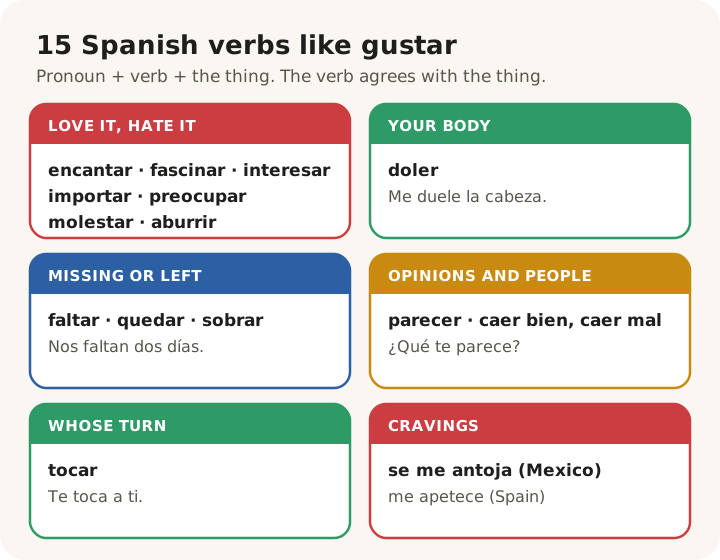
Spanish verbs like gustar all follow the same pattern: pronoun + verb + the thing, and the verb agrees with the thing. So ask “what is pleasing, hurting or missing?” instead of “who?”
Love it, hate it
Encantar is “to love” for things (me encantan los tacos). Then fascinar (me fascina la historia), interesar (nos interesa el arte), importar (no me importa, “I don’t care”), preocupar (me preocupa el examen), molestar (me molesta el ruido) and aburrir (me aburren las reuniones largas).
Me fascina la historia.
History fascinates me.
Me preocupa el examen.
The exam worries me.
Me aburren las reuniones largas.
Long meetings bore me.
Your body
Doler, “to hurt.” Ask what hurts? One thing: me duele la cabeza. Two feet: me duelen los pies.

What’s missing or left
Faltar (to be missing), quedar (to have left) and sobrar (to have too much): nos faltan dos días para las vacaciones, me quedan diez pesos, nos sobró comida. Quedar also means “to fit”: esa camisa te queda muy bien. More forms on the quedar page.
Nos faltan dos días para las vacaciones.
We have two days to go until vacation.
Esa camisa te queda muy bien.
That shirt looks great on you.
Opinions and people
Parecer asks for an opinion: ¿Qué te parece el plan? (what do you think of the plan?). Caer bien and caer mal are about people: me cae muy bien tu novio, “I really like your boyfriend.” See the parecer and caer pages for every form.
Whose turn and cravings
Tocar tells you whose turn it is: te toca a ti. For cravings, Spain says ¿te apetece un café? For a craving in Latin America, Mexico especially, you’ll hear se me antoja.
Se me antoja un café means “I feel like a coffee”; the extra se comes along with the verb (antojarse), and the rest is the same pattern.
Te toca a ti.
It's your turn.
Se me antoja un café.
I feel like a coffee.
¿Te apetece un café?
Do you feel like a coffee?
Is gustar reflexive?
No. The me in me gusta looks like a reflexive pronoun, but it’s an indirect object: the coffee pleases me. Some verbs on this list do have a reflexive twin, though. Me aburre la clase is “the class bores me”; me aburro en clase is “I get bored in class,” with aburrirse and I as the subject.
“I like you”: me gustas vs me caes bien
When a person is the one doing the pleasing, the verb agrees with them: me gustas is “I like you,” and it means attraction. For a coworker or a new friend, use me caes bien.
Try it: gusta or gustan?
Gusta or gustan?
0 of 8Me ___ los gatos.
A mi hermana le ___ correr.
¿Te ___ las películas de terror?
A nosotros ___ encanta la playa.
Me ___ la espalda.
—Me gusta el café. —A mí ___.
Ayer me ___ mucho el concierto.
¿Qué te ___ mis amigos?
The gustar exercises have 22 sentences with audio and a worksheet you can print.

Spanish teacher · B.A. in Spanish (UnB) · 10+ years teaching
Spanish teacher with a degree in Spanish from the University of Brasília (UnB) and more than 10 years teaching.


