
On this page
In this post
- The six patterns of irregular verbs
- The 20 most common irregular verbs, with audio
- Every irregular verb in the conjugator's index, by pattern
- How vos and vosotros change the picture
Spanish irregular verbs are verbs that break the regular pattern of their group, and most of them break it in a place English speakers don’t expect. In English, irregular verbs live in the past: go, went; have, had. In Spanish, the biggest surprises are in the present tense, often in the yo form alone: tengo (I have), voy (I go), conozco (I know).
They’re also unavoidable. The ten most frequent verbs in Spanish (ser, estar, haber, tener, hacer, poder, decir, ir, ver, dar) are all irregular. The good news: almost every irregular form fits one of six patterns, and once you know the pattern, you know the family. This page is part of the bigger map of Spanish verbs.
What makes Spanish irregular verbs irregular
A regular verb keeps its stem and swaps the ending. Hablar gives habl- + -o = hablo, and every -ar verb in that group does the same thing. An irregular verb changes something else. The stem gets a new vowel (poder → puedo), the yo form picks up an extra letter (salir → salgo), or the whole verb turns into something new (ir → voy).
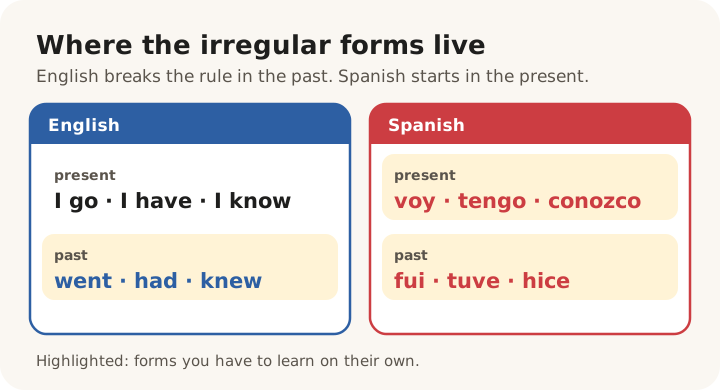
That’s why irregular verbs in Spanish feel harder at first: you meet them on day one. Soy de Chicago, tengo veinte años, voy al trabajo. Three sentences, three irregular verbs, all in the present.
The 20 most common irregular Spanish verbs
These are the 20 most common irregular Spanish verbs, in order of frequency (Verbos.app, Los 100 verbos más usados en español). Each one links to its full table, where every irregular form is marked in red and has audio.
| # | Verb | Meaning | Yo, present | Yo, preterite | Pattern |
|---|---|---|---|---|---|
| 1 | ser | to be | soy | fui | truly irregular |
| 2 | estar | to be | estoy | estuve | -oy + past stem |
| 3 | haber | to have (auxiliary) | he | hube | truly irregular |
| 4 | tener | to have | tengo | tuve | yo-go + e → ie |
| 5 | hacer | to do, to make | hago | hice | yo-go |
| 6 | poder | can | puedo | pude | o → ue |
| 7 | decir | to say | digo | dije | yo-go + e → i |
| 8 | ir | to go | voy | fui | truly irregular |
| 9 | ver | to see | veo | vi | yo form |
| 10 | dar | to give | doy | di | -oy |
| 11 | saber | to know | sé | supe | yo form + past stem |
| 12 | querer | to want | quiero | quise | e → ie |
| 13 | poner | to put | pongo | puse | yo-go |
| 14 | parecer | to seem | parezco | parecí | -zco |
| 15 | seguir | to follow | sigo | seguí | e → i |
| 16 | encontrar | to find | encuentro | encontré | o → ue |
| 17 | venir | to come | vengo | vine | yo-go + e → ie |
| 18 | pensar | to think | pienso | pensé | e → ie |
| 19 | salir | to go out | salgo | salí | yo-go |
| 20 | volver | to come back | vuelvo | volví | o → ue |
Listen to some of them at work in everyday sentences:
Yo no puedo ir mañana.
I can't go tomorrow.
Yo salgo de casa a las ocho.
I leave home at eight.
Yo siempre pongo la mesa.
I always set the table.
Yo no sé nada de eso.
I don't know anything about that.
Yo no conozco a nadie en esta ciudad.
I don't know anyone in this city.
¿Me dices la verdad?
Will you tell me the truth?
Ella duerme ocho horas por noche.
She sleeps eight hours a night.
Ellos vienen a las nueve.
They're coming at nine.
The 6 patterns of irregular verbs
Here’s the map. Most irregular forms you’ll meet in your first two years of Spanish fall into one of these boxes, and a few big verbs sit in two or three at once.

Truly irregular: ser, ir and haber
There’s no rule to find here. Ser (to be) gives soy, eres, es, somos, son. Ir (to go) gives voy, vas, va, vamos, van. Haber gives he, has, ha, hemos, han, plus hay for “there is” and “there are.” Learn them as words.
A few others are irregular in the yo form and regular after that. Estar and dar end in -oy like voy: estoy, doy. Saber gives sé, and ver gives veo.
Voy al supermercado.
I'm going to the supermarket.
Hay un restaurante muy bueno aquí.
There's a really good restaurant here.
Te doy mi número.
I'll give you my number.
Yo-go verbs (the go verbs in Spanish)
Why does tener give tengo and not teno? Because it’s a yo-go verb: in the present tense, only the yo form ends in -go. The other forms go back to normal or follow a stem change. Here are the go verbs in Spanish you’ll use every day:
| Infinitive | Yo | Tú | Also changes |
|---|---|---|---|
| tener | tengo | tienes | e → ie |
| venir | vengo | vienes | e → ie |
| decir | digo | dices | e → i |
| hacer | hago | haces | |
| poner | pongo | pones | |
| salir | salgo | sales | |
| traer | traigo | traes | |
| caer | caigo | caes | |
| oír | oigo | oyes | y in oyes, oye, oyen |

Verbs built on these behave the same way: mantener and obtener go like tener (mantengo, obtengo). And the -go returns in the whole present subjunctive (tenga, haga, salga), which is covered in present subjunctive in Spanish.
Tengo dos hermanos.
I have two brothers.
Salgo del trabajo a las seis.
I leave work at six.
Te traigo un regalo.
I've brought you a gift.
-zco verbs: conozco, parezco, conduzco
A rule with very few exceptions: verbs ending in a vowel + -cer or -cir add a z in the yo form. Conocer → conozco, parecer → parezco, nacer → nazco, conducir → conduzco. Also ofrecer → ofrezco and traducir → traduzco. Every other present form is regular: conoces, conoce, conocemos. The two exceptions you’ll meet early are hacer and decir, which are yo-go verbs instead (hago, digo).
Stem changing verbs: e → ie, o → ue, e → i
Stem changing verbs are the biggest family, and the boot chart lives in their own lesson: Spanish stem changing verbs. In short:
- e → ie: pensar → pienso, querer → quiero
- o → ue: poder → puedo, dormir → duermo
- e → i (only -ir verbs): pedir → pido, seguir → sigo
- u → ue (only jugar): juego
The change happens in four forms of the present (yo, tú, él, ellos). Nosotros stays regular: pensamos, podemos.
Irregular in the past only
Some verbs are perfectly normal in the present and break the rule in the preterite. Andar (to walk) is ando today and anduve yesterday. Many of the big verbs also take a new stem in the preterite: tener → tuve, hacer → hice, decir → dije, poder → pude. Those stems, with their endings, are the subject of irregular preterite verbs.
And busqué, llegué, empecé? Those aren’t irregular at all. It’s a spelling change to keep the sound, explained in car, gar, zar verbs.
Irregular future stems and past participles
Twelve verbs shorten or change their stem in the future and conditional: tener → tendré, hacer → haré, decir → diré, poder → podré, salir → saldré. And a handful have an irregular past participle, the form you use with he, has, ha: hecho (done), dicho (said), escrito (written), visto (seen), vuelto (returned), puesto (put). Both lists come up again when you study the future and the present perfect.
Irregular Spanish verbs list, by pattern
Below are all the Spanish irregular verbs in our conjugator’s index, sorted by pattern, with the forms that show the pattern best. The list comes from the conjugator’s own irregularity marks, not from memory. Click any verb to see all of its forms, the red ones included, and hear each of them.
Truly irregular or irregular yo
| Verb | Yo, present | Yo, preterite | Yo, future |
|---|---|---|---|
| ser | soy | fui | seré |
| ir | voy | fui | iré |
| haber | he | hube | habré |
| estar | estoy | estuve | estaré |
| dar | doy | di | daré |
| saber | sé | supe | sabré |
| ver | veo | vi | veré |
Yo-go and -zco
| Verb | Yo, present | Yo, preterite | Yo, future |
|---|---|---|---|
| tener | tengo | tuve | tendré |
| venir | vengo | vine | vendré |
| poner | pongo | puse | pondré |
| salir | salgo | salí | saldré |
| hacer | hago | hice | haré |
| decir | digo | dije | diré |
| traer | traigo | traje | traeré |
| caer | caigo | caí | caeré |
| oír | oigo | oí | oiré |
| mantener | mantengo | mantuve | mantendré |
| obtener | obtengo | obtuve | obtendré |
| conocer | conozco | conocí | conoceré |
| parecer | parezco | parecí | pareceré |
| nacer | nazco | nací | naceré |
| conducir | conduzco | conduje | conduciré |
Stem changing
| Verb | Yo, present | Yo, preterite | Pattern |
|---|---|---|---|
| pensar | pienso | pensé | e → ie |
| querer | quiero | quise | e → ie, past stem quis- |
| empezar | empiezo | empecé | e → ie |
| comenzar | comienzo | comencé | e → ie |
| cerrar | cierro | cerré | e → ie |
| entender | entiendo | entendí | e → ie |
| perder | pierdo | perdí | e → ie |
| sentir | siento | sentí | e → ie |
| defender | defiendo | defendí | e → ie |
| poder | puedo | pude | o → ue, past stem pud- |
| volver | vuelvo | volví | o → ue |
| contar | cuento | conté | o → ue |
| encontrar | encuentro | encontré | o → ue |
| recordar | recuerdo | recordé | o → ue |
| dormir | duermo | dormí | o → ue |
| morir | muero | morí | o → ue |
| probar | pruebo | probé | o → ue |
| resolver | resuelvo | resolví | o → ue |
| jugar | juego | jugué | u → ue |
| pedir | pido | pedí | e → i |
| servir | sirvo | serví | e → i |
| repetir | repito | repetí | e → i |
| seguir | sigo | seguí | e → i |
| conseguir | consigo | conseguí | e → i |
| elegir | elijo | elegí | e → i |
Irregular in the past only: andar (ando, but anduve).
Need it on paper? The printable verb tables put 50 of the most used verbs on a few pages, irregular ones included.
Irregular verbs in Latin America and Spain
Here’s a question few charts answer: are Spanish irregular verbs the same everywhere? The forms are, with one big exception: vos.
In Argentina, Uruguay, Paraguay and much of Central America, people say vos instead of tú. Vos forms carry the stress on the ending, and that switches off the stem change. So tú puedes becomes vos podés, tú quieres becomes vos querés, tú tienes becomes vos tenés, and tú duermes becomes vos dormís. Ser gets its own form: vos sos. Ir stays vos vas.

Vos sos de acá, ¿no?
You're from around here, right?
¿Vos tenés tiempo mañana?
Do you have time tomorrow?
Vosotros, the plural “you” used only in Spain, also stays outside the stem change: podéis, queréis, tenéis. In Latin America the plural is always ustedes, which takes the same form as ellos: ustedes pueden, ustedes tienen. If you’re learning for Mexico, Colombia or the US, you can treat vosotros as something to recognize, not produce.
How to learn irregular verbs in Spanish
Spanish is my second language too, and what I’ve seen work with my students isn’t more charts. It’s fewer charts, a light explanation, and a lot of Spanish to hear and say. Three habits:
- Pattern before list. When you meet a new irregular verb, ask which box it goes in. Proponer? It’s poner with a prefix, so propongo. You didn’t memorize anything new.
- Yo first. The yo form tells you the most. If yo is odd (tengo, conozco), the subjunctive will be odd the same way (tenga, conozca).
- Mix them up. In conversation, tengo, fui and sepa don’t arrive in neat rows; they come from different verbs and tenses, one after another. The irregular verb challenge at the end of this page works the same way. Get the 20 verbs in the table above solid first, and leave conducir for later.
Ready for a quick check? Pick the right form:
Irregular verbs: quick check
0 of 8Yo ___ veinte años. (tener)
Yo no ___ a tu hermano. (conocer)
¿Tú ___ ir al cine? (querer)
Nosotros ___ salir temprano. (poder)
Yo ___ de Chicago. (ser)
Ellos ___ la verdad. (decir)
Yo ___ la tarea ahora. (hacer)
Vos ___ muy simpático. (ser)
Frequently asked questions
How many irregular verbs are there in Spanish?
There’s no single official number, because it depends on what you count (is busqué irregular? most grammars say no). Here’s a count you can check: of the 710 verbs in our Spanish conjugator, 187 have at least one form that breaks the regular pattern. The ones you’ll use most are the 20 in the table above.
Is tener irregular?
Very. Tener is irregular in four ways at once. It’s yo-go in the present (tengo) and e → ie in the other present forms (tienes, tiene). It also takes a new stem in the preterite (tuve) and a short stem in the future (tendré).
Which common irregular Spanish verbs should I learn first?
Ser, estar, tener, ir, hacer and poder. With those six you can say who you are, where you are, what you have, where you’re going, what you do and what you can do. Then add querer, decir, saber, venir and salir.
Are irregular verbs used differently in Spain and Latin America?
The meanings are the same. The forms change only in two places: vos (Argentina, Uruguay, Central America), which drops the stem change (vos podés), and vosotros (Spain only), which also keeps the stem regular (podéis).
Test yourself: the irregular verb challenge
Ten irregular forms are waiting in the conjugation trainer. Each round shows you one form, from the present, the preterite, the future or the subjunctive, and you pick the verb it comes from. Open the irregular verb challenge and see how many you get on the first try. When you want full sentences with audio, the irregular verbs practice has 20 of them and a printable sheet with answers.

Spanish teacher · B.A. in Spanish (UnB) · 10+ years teaching
Spanish teacher with a degree in Spanish from the University of Brasília (UnB) and more than 10 years teaching.


