
On this page
In this post
- The one question that picks ser or estar
- DOCTOR, PLACE and the four places they break
- Adjectives that change meaning with each verb
- The "to be" that turns into tener, hacer or hay
Ser vs estar is the difference between soy aburrido, “I’m boring,” and estoy aburrido, “I’m bored.” Same adjective, same English verb, and a completely different thing to say about yourself. The Spanish verb to be comes in two forms because Spanish asks a question English never asks: are you describing what something is, or how and where it is right now?
Soy aburrido.
I'm boring.
Estoy aburrido.
I'm bored.
That question gets you through most sentences. Then come the uses of each verb and the memory tricks everyone teaches (DOCTOR and PLACE), with the four spots where those tricks fail. After that: the adjectives that switch meaning, the cases where both verbs work, and a quiz that corrects itself.
Ser vs estar: the difference in one question
Before you pick a verb, ask: is this what it is, or how or where it is right now?
The difference between estar and ser comes down to that. Ser describes identity: who someone is, what something is like, where it comes from, what it’s made of. Estar describes a state or a position: how someone feels today, where something is, what condition it’s in after something happened.

Notice that the question isn’t “permanent or temporary.” Most textbooks start there, and it works for a while. Then you meet soy estudiante (temporary, yet ser) and está muerto (permanent, yet estar), and the rule falls apart. “What it is” vs “how or where it is” survives those cases, as you’ll see further down.
If you just need the third-person forms, es and está, there’s a short guide on es vs está (and esta without the accent).
When to use ser
Ser is the verb of identity, and there are six cases where you only use ser. Use it when the description would still be true if you met the person or thing tomorrow, in another place, in another mood.
Who or what something is
Names, jobs, nationality, religion, relationships. Soy Ana. Es mi hermana. Somos colombianos. A job takes ser even if you started it last week: soy profesora.
Where it’s from
Origin is part of identity: Mi familia es de Colombia. Where you live now is a location, so that one goes with estar (or with vivir).
What it’s like
The traits you’d use to describe someone to a friend who hasn’t met them: tall, funny, smart, shy. Mi hermano es alto y muy divertido.
Time, days and dates
Clock time and dates take ser, in the plural from two o’clock on: Son las diez y cuarto. Hoy es martes.
What it’s made of and whose it is
La mesa es de madera (the table is made of wood). Este libro es mío (this book is mine).
Where an event takes place
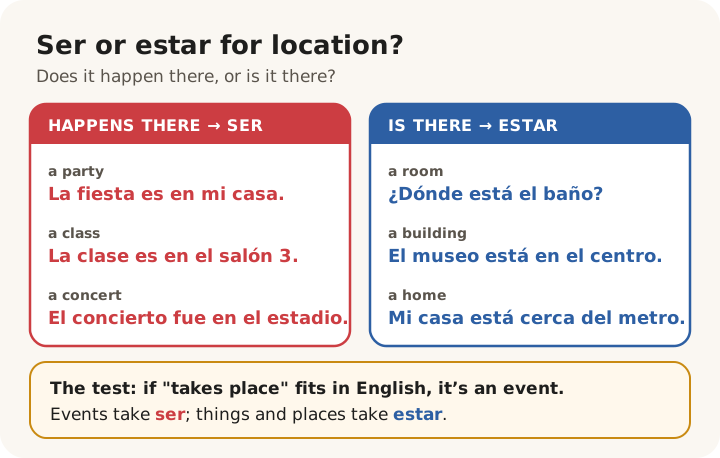
A party, a class or a wedding doesn’t sit anywhere. It happens somewhere, so it takes ser: La fiesta es en mi casa.
Soy profesora de español.
I'm a Spanish teacher.
Mi familia es de Colombia.
My family is from Colombia.
Mi hermano es alto y muy divertido.
My brother is tall and really funny.
Son las diez y cuarto.
It's a quarter past ten.
Este libro es mío.
This book is mine.
La fiesta es en mi casa.
The party is at my house.
When to use estar
Estar is the verb of states and positions. Use it for anything that answers “where?” or “how is it right now?”
Where people and things are
¿Dónde está el baño? Cities and buildings too: El museo está en el centro de Lima.
How someone feels
Tired, sick, happy, nervous, in a bad mood. ¿Estás enfermo? Tienes mala cara.
The result of an action
When a verb has done its job, estar + past participle describes what’s left: the store was closed, so now la tienda está cerrada. The dinner got made, so la cena está lista.
An action in progress
Estar + the -ndo form works like English “to be + -ing”: estoy trabajando, “I’m working.” This is one of the few places where the two languages line up perfectly.
Dates, prices and temperature
Three set phrases with estar a: Estamos a martes (it’s Tuesday, “we’re at Tuesday”), estamos a treinta grados (it’s thirty degrees), ¿a cuánto están los tomates? (how much are the tomatoes today?).
¿Dónde está el baño?
Where's the bathroom?
¿Estás enfermo? Tienes mala cara.
Are you sick? You don't look well.
La cena está lista.
Dinner is ready.
Estoy trabajando.
I'm working.
Estamos a treinta grados.
It's thirty degrees.
¿A cuánto están los tomates?
How much are the tomatoes?
DOCTOR and PLACE, and the four places they break
Almost every teacher hands you these two acronyms, and they’re useful as a checklist:
| DOCTOR (ser) | PLACE (estar) |
|---|---|
| Description: es alta | Position: está sentado |
| Occupation: es doctor | Location: está en Lima |
| Characteristic: es simpático | Action in progress: está comiendo |
| Time: son las tres | Condition: está roto |
| Origin: es de Chile | Emotion: está feliz |
| Relationship: es mi novio |

They work until they don’t. Here are the four places where they break, and how the “what it is vs how or where it is” question fixes each one.
1. Events. PLACE says location goes with estar. But estar vs ser for location depends on what’s being located. A thing or a place is somewhere: Mi casa está cerca. An event happens somewhere: La fiesta es en mi casa. Test it in English: if “takes place” fits, use ser.
2. Death. Nothing is more permanent, yet it’s está muerto. Spanish sees death as the state someone ended up in, like está roto or está cerrado. To say when it happened, use the verb morir: Mi abuelo murió en 2010.
3. Age and traits. Es joven (he’s young) takes ser even though youth doesn’t last, because it’s a characteristic. Same with soy estudiante: temporary, but it’s what you are.
4. Dates. Hoy es martes follows DOCTOR (time). Estamos a martes also exists and means the same thing. Both are right; estamos a just frames the date as a point you’ve reached.
Mi abuelo está muerto desde hace años.
My grandfather has been dead for years.
Hoy es martes.
Today is Tuesday.
If you want every use and example on a single page you can print, the ser vs estar chart has the whole thing.
Adjectives that change meaning with ser and estar
This is where ser vs estar stops being a grammar point and starts changing what you actually say. With these adjectives, ser gives you the trait and estar gives you the state, and the two can be miles apart in English.
| Adjective | with ser | with estar |
|---|---|---|
| listo | clever | ready |
| aburrido | boring | bored |
| seguro | safe | sure |
| malo | bad (a bad person, a bad movie) | sick, or gone bad (food) |
| rico | rich | delicious |
| verde | green | unripe |
| vivo | sharp, quick-witted | alive |
| bueno | good | tasty (of food) |
Estar vs ser with the same adjective: the trait on the left, the state on the right.
Seguro is the one that trips up English speakers most. The Diccionario de la lengua española lists both senses: “free from risk” and “certain.” Este barrio es seguro is “this neighborhood is safe.” Estoy seguro is “I’m sure.” Soy seguro describes your personality (a confident person), not how certain you are.
Ese niño es muy listo, aprende todo rápido.
That boy is really clever, he learns everything fast.
¿Estás listo? Nos vamos.
Are you ready? We're leaving.
Este barrio es seguro.
This neighborhood is safe.
Estoy seguro de que viene.
I'm sure he's coming.
Su familia es rica.
Her family is rich.
Los tacos están muy ricos.
The tacos are really good.
La leche está mala.
The milk has gone bad.
El plátano está verde.
The banana isn't ripe yet.

One word of warning about bueno. La sopa está buena means the soup tastes good. Said about a person, está bueno or está buena means “he’s hot” or “she’s hot.” Use es buena persona when you mean someone is kind.
When you can use either
Some sentences accept both verbs, and both are correct Spanish. Here’s when to use estar and ser with the same adjective: the grammar doesn’t change, your point of view does.
- Marital status. Soy casada and estoy casada both mean “I’m married,” and you’ll hear both every day. Estar frames it as your current situation; ser presents it as part of who you are (soy casada, no soltera).
- Looks. Es guapa means she’s good-looking, period. Está guapa hoy means she looks great today, maybe with a new haircut.
- Happiness. Soy feliz is a statement about your life. Estoy feliz is about right now: you got the job, the sun came out.
Estoy casada desde hace cinco años.
I've been married for five years.
Hoy estás muy guapa.
You look really nice today.
Soy feliz con mi vida.
I'm happy with my life.

When both verbs are possible, the speaker picks the meaning. That’s why the “what it is vs how it is right now” question is more useful than any list.
The Spanish verb “to be” that isn’t ser or estar
Here’s a mistake no acronym prepares you for. Sometimes English “to be” turns into a third verb in Spanish, and using ser or estar there sounds strange.
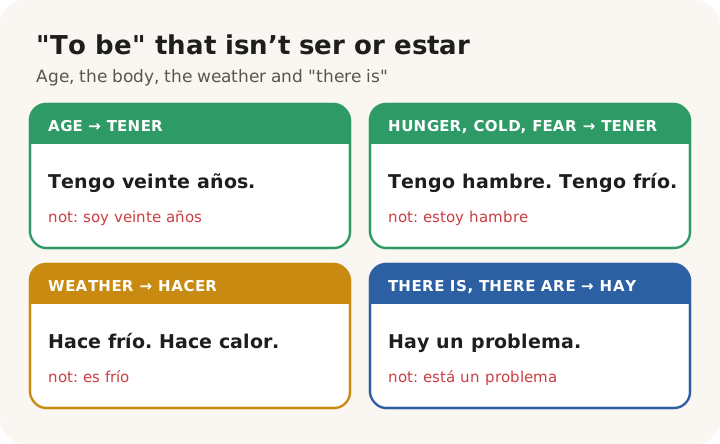
- Age takes tener: tengo veinte años, literally “I have twenty years.” Never soy veinte años.
- Hunger, thirst, cold, heat, fear, sleepiness take tener: tengo hambre, tengo frío, tengo miedo. Estoy frío would mean your body is cold to the touch.
- Weather takes hacer: hace frío, hace calor, hace sol.
- “There is / there are” takes hay: hay un problema, hay dos bancos en esta calle.
Tengo veinte años.
I'm twenty years old.
Tengo hambre.
I'm hungry.
Hoy hace mucho frío.
It's really cold today.
Hay un problema con mi cuenta.
There's a problem with my account.
Hay vs está has its own trap: hay un banco cerca (there’s a bank nearby, any bank) vs el banco está cerca (the bank you mean is nearby). You can practice that pair in the tener vs haber exercises, and see every form on the tener and haber pages.
Ser and estar in the present tense
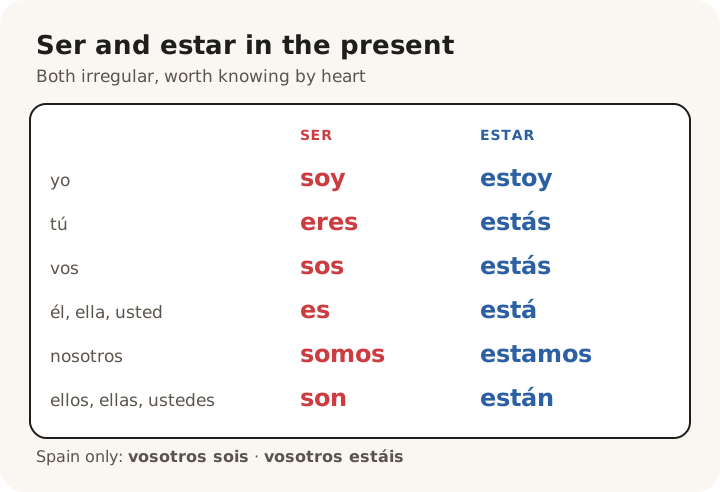
Both verbs are irregular, so it’s worth knowing the present tense by heart.
| Person | ser | estar |
|---|---|---|
| yo | soy | estoy |
| tú | eres | estás |
| vos | sos | estás |
| él, ella, usted | es | está |
| nosotros, nosotras | somos | estamos |
| ellos, ellas, ustedes | son | están |
Vos sos is what you’ll hear in Argentina, Uruguay and much of Central America instead of tú eres. In Spain, vosotros adds sois and estáis.
Every other tense, with audio for each form, is on the pages for ser and estar. To drill soy, estoy, eres, estás until they come out on their own, try the conjugation practice.
Ser and estar in real conversations
Four short clips from street interviews. Listen for the verb in bold, then think about which question it answers.

- Cuando trabajaste, ¿qué era lo que te gustaba hacer?When you were working, what was it you liked to do? · Easy Spanish · Valle de Bravo, Mexico
- ¿Cuál sería para ti la mejor tortilla?What would be the best tortilla for you? · Easy Spanish · Mexico City
- Ya después de una relación a distancia, por fin pudimos casarnos y estoy aquí.After a long-distance relationship, we finally got married and here I am. · Easy Spanish · a Mexican woman in Berlin
- La zona aquí está mejor que donde estábamos antes.The area here is better than where we were before. · Easy Spanish · Barcelona, Spain
Era and sería are ser in the past and the conditional: they ask what something was or would be. Estoy aquí and donde estábamos are pure location, so they take estar.
Ser or estar? Quiz
Ser or estar?
0 of 10Mi papá ___ ingeniero.
Lima ___ en la costa de Perú.
El concierto ___ en el estadio.
¿Por qué ___ tan triste hoy?
Los tacos ___ muy ricos.
Mi tía ___ muy rica: tiene tres casas.
Mi abuelo ___ muerto.
___ las ocho de la noche.
¿___ lista? Ya nos vamos.
Yo ___ veinticinco años.
Ready for more? The ser vs estar exercises have 25 sentences with audio and a worksheet with the answer key, ready to print.
Frequently asked questions
Is it soy casado or estoy casado?
Both are correct. Estoy casado describes your situation; soy casado presents it as part of who you are. Divorced and single work the same way.
Why is it está muerto?
Because Spanish treats death as the state someone is in after dying, the same way está roto describes something after it broke. The “temporary” idea doesn’t apply here. To say when someone died, switch verbs: murió en 2010.
What’s the difference between estar and ser in the past?
The same as in the present, with a tense choice on top. Fue and era come from ser; estuvo and estaba come from estar. La fiesta fue increíble (the party was amazing), el museo estaba cerrado (the museum was closed). Choosing between fue and era is a separate question, covered in preterite vs imperfect.
Is ser for permanent things and estar for temporary ones?
As a first guess, often yes. As a rule, no: soy estudiante is temporary and takes ser, está muerto is permanent and takes estar. Ask “what it is, or how and where it is right now” instead, and those cases stop being exceptions.
How do I know when to use estar and ser?
Go back to the one question, then check the chart. The ser vs estar chart puts every use on one page with an example you can hear, plus a blank version to fill in and print.

Spanish teacher · B.A. in Spanish (UnB) · 10+ years teaching
Spanish teacher with a degree in Spanish from the University of Brasília (UnB) and more than 10 years teaching.


