

On this page
In this post
- The three steps from hablo to hable
- Irregular yo forms, stem changes and spelling changes
- DISHES: the six verbs that break the pattern
- When you'll need it, in short
Present subjunctive Spanish forms all come from one place: the yo form of the present. Take hablo, drop the -o, add the opposite vowel, and you have hable. That’s the whole procedure, and it works for almost every verb you know.
Quiero que vengas a mi cumpleaños.
I want you to come to my birthday party.
Ojalá haga sol mañana.
I hope it's sunny tomorrow.
One thing before the forms: the subjunctive is a mood, not a tense. It doesn’t place an action in time; it marks it as wished for, doubted or not yet real. Here we’re dealing with how to build it, with a short section on when to use it near the end.
How present subjunctive Spanish endings work
Spanish subjunctive conjugation starts from yo, and it takes three steps:
- Conjugate the verb in the present, yo form: hablo, como, vivo.
- Drop the final -o: habl-, com-, viv-.
- Add the ending with the opposite vowel: -ar verbs take e, -er and -ir verbs take a.
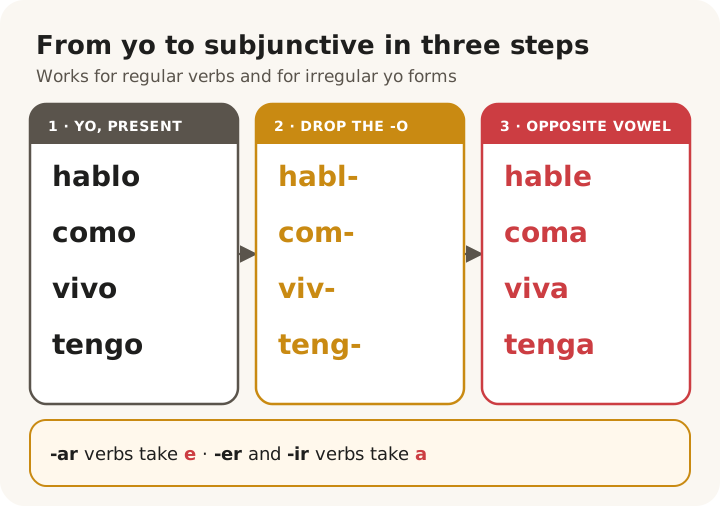
“Opposite vowel” is the part to remember. In the regular present, -ar verbs live on a (habla) and -er/-ir verbs live on e (come, vive). The subjunctive swaps them.

| Person | hablar | comer | vivir |
|---|---|---|---|
| yo | hable | coma | viva |
| tú, vos | hables | comas | vivas |
| él, ella, usted | hable | coma | viva |
| nosotros | hablemos | comamos | vivamos |
| vosotros (Spain) | habléis | comáis | viváis |
| ellos, ellas, ustedes | hablen | coman | vivan |
Regular endings of the Spanish subjunctive conjugation: -e for -ar verbs, -a for -er and -ir verbs.
Notice that yo and él share a form (hable), so context or a pronoun tells them apart. About vos: according to the RAE’s guide to voseo, in Argentina the tú form and a vos form alternate in the present subjunctive (que vos pienses, que vos pensés), while Uruguay and Paraguay prefer the tú form.
Irregular yo forms carry over: tenga, haga, conozca
Here’s why starting from yo matters. Many common verbs have an irregular yo in the present, and the subjunctive simply inherits it. You don’t need a new list.
| Verb | yo (present) | Subjunctive |
|---|---|---|
| tener | tengo | tenga |
| hacer | hago | haga |
| decir | digo | diga |
| poner | pongo | ponga |
| salir | salgo | salga |
| venir | vengo | venga |
| traer | traigo | traiga |
| oír | oigo | oiga |
| conocer | conozco | conozca |
| ver | veo | vea |
If you tried to build these from the infinitive, you’d get tena or hacea. From yo, they come out right every time, and the g or zc stays in all six persons: tengamos, conozcan.
Es mejor que salgamos temprano.
We'd better leave early.
No quiero que digas nada.
I don't want you to say anything.
Stem changing verbs in the present subjunctive
Stem changes come back in the subjunctive with the same “boot” shape as the present: every person changes except nosotros and vosotros. Pensar gives piense, volver gives vuelva.
The -ir verbs add one detail. In nosotros and vosotros, they still change, to a smaller vowel: e becomes i, o becomes u.
| pensar (-ar) | dormir (-ir) | sentir (-ir) | pedir (-ir) | |
|---|---|---|---|---|
| yo | piense | duerma | sienta | pida |
| tú | pienses | duermas | sientas | pidas |
| él, ella | piense | duerma | sienta | pida |
| nosotros | pensemos | durmamos | sintamos | pidamos |
| ellos | piensen | duerman | sientan | pidan |

Es importante que duermas bien.
It's important that you sleep well.
Es mejor que pidamos una pizza.
We'd better order a pizza.
The full picture of these verbs, with every pattern, is in Spanish stem-changing verbs. Forms for each one are on the pages for pensar, volver, dormir, sentir and pedir.
Spelling changes: -car, -gar, -zar, -ger, -guir
Some verbs change a letter, not a sound. When the ending switches vowel, Spanish spelling has to adjust to keep the same consonant sound:
| Ending | Change | Example |
|---|---|---|
| -car | c → qu | buscar → busque |
| -gar | g → gu | llegar, pagar → llegue, pague |
| -zar | z → c | empezar → empiece |
| -ger | g → j | escoger → escoja |
| -guir | gu → g | seguir → siga |
Busce would be pronounced “BOOS-seh,” so the c becomes qu to keep the hard k sound. Same logic for llegue: the silent u keeps the g hard. The car, gar, zar verbs guide covers the preterite version of the same rule.
Cuando llegues, avísame.
When you get there, let me know.
Quiero que busques las llaves.
I want you to look for the keys.
Irregular subjunctive verbs: DISHES
Only six verbs ignore the three steps. The word DISHES keeps them together: dar, ir, ser, haber, estar, saber. Their yo forms (doy, voy, soy, he, estoy, sé) don’t end in -o the usual way, so the procedure has nothing to start from.
| Verb | Subjunctive | Example |
|---|---|---|
| dar | dé, des, dé, demos, den | Dile que me dé su número. |
| ir | vaya, vayas, vaya, vayamos, vayan | Que te vaya bien en el examen. |
| ser | sea, seas, sea, seamos, sean | No creo que sea tan difícil. |
| haber | haya, hayas, haya, hayamos, hayan | Dudo que haya mesa libre. |
| estar | esté, estés, esté, estemos, estén | Espero que estés bien. |
| saber | sepa, sepas, sepa, sepamos, sepan | No quiero que sepan nada. |
Two of them carry accent marks you can’t skip. Dé (give) needs it to stand apart from de (of). Esté and estés keep the stress of estar: without the mark, este is “this.”
Dile que me dé su número.
Tell him to give me his number.
Que te vaya bien en el examen.
Good luck on the exam.
No creo que sea tan difícil.
I don't think it's that hard.
Dudo que haya mesa libre.
I doubt there's a free table.
Espero que estés bien.
I hope you're well.
No quiero que sepan nada.
I don't want them to know anything.

These are the irregular subjunctive verbs people mean when they say the subjunctive is hard. Everything else follows the three steps.
When you’ll need it: subjunctive or indicative, the short version
Start with five triggers you’ll hear all the time:
| Trigger | Meaning | Example |
|---|---|---|
| quiero que | I want (someone else) to | Quiero que vengas. |
| ojalá | I hope | Ojalá haga sol. |
| es importante que | it’s important that | Es importante que duermas bien. |
| no creo que | I don’t think | No creo que sea difícil. |
| cuando + future | when (it hasn’t happened yet) | Cuando llegues, avísame. |

Two pairs trip up English speakers. Creo que tienes razón uses the indicative, because you’re stating what you believe. Add no, and it flips: no creo que tengas razón. And si never takes the present subjunctive: si tengo tiempo, te ayudo, exactly like English “if I have time.”
Creo que tienes razón.
I think you're right.
Si tengo tiempo, te ayudo.
If I have time, I'll help you.
Cuando catches people too. English says “when you get there,” in the present, so learners write cuando llegas. For something still in the future, Spanish wants cuando llegues. For a habit, it’s back to the indicative: cuando llego a casa, me ducho.
The big picture (the three moods, the places where the subjunctive shows up and its four tenses) is in the Spanish subjunctive guide. To practice the ones above right now, try the Spanish subjunctive exercises: 20 sentences with audio and a worksheet with answers.
Present subjunctive in Spanish examples you’ll hear
Some subjunctive sentences are so common they work like set phrases. You’ll hear these every week:
¡Que te vaya bien!
Good luck! / Take care!
Que descanses.
Get some rest.
Que tengas buen viaje.
Have a good trip.
¡Que te mejores!
Get well soon!
¡Que cumplas muchos más!
Many happy returns!
Pide lo que quieras, yo invito.
Order whatever you want, it's on me.
The pattern is que + subjunctive, with “I hope” left out. These present subjunctive in Spanish examples are worth learning as whole chunks.
Subjunctive or indicative?
0 of 8Quiero que tú ___ conmigo.
Creo que ___ razón.
No creo que ___ tan difícil.
Si ___ tiempo, te llamo.
Cuando ___ a casa, avísame.
Cuando ___ a casa, siempre me ducho.
Ojalá ___ sol mañana.
Es importante que ___ bien.
To drill the forms on their own, the conjugation practice in subjunctive mode gives you a verb and a person, and checks what you type.
Now try the procedure on a verb we haven’t touched: elegir (to choose). The yo form is elijo. Drop the -o: elij-. Add the opposite vowel: elija, elijas, elijamos. The stem change and the spelling change both came along for free, because they were already in elijo. Check your answer on the elegir page.

Spanish teacher · B.A. in Spanish (UnB) · 10+ years teaching
Spanish teacher with a degree in Spanish from the University of Brasília (UnB) and more than 10 years teaching.


