On this page
In this post
- The -ía endings, and how not to mix up comía and comería
- The 12 irregular stems, borrowed from the future
- Five uses, from me gustaría to serían las diez
- Three kinds of would that aren't the conditional
The Spanish conditional tense is how you say would: hablaría, I would speak. It’s also the tense that turns an order into a request. Picture yourself at the door of a busy restaurant in Bogotá, asking for a table:
Quiero una mesa para dos.
I want a table for two.
Me gustaría una mesa para dos.
I'd like a table for two.
Both get you the table, but the second sounds like “I’d like” instead of “I want.” That softening is the job you’ll use most. The forms are quick; the uses are where English speakers slip, because English would doesn’t always mean the conditional.
How to form the Spanish conditional tense
Take the whole infinitive and add -ía, -ías, -ía, -íamos, -íais, -ían. For the conditional tense, Spanish conjugation couldn’t be simpler: one set of endings for -ar, -er and -ir verbs alike.
| Person | hablar | comer | vivir |
|---|---|---|---|
| yo | hablaría | comería | viviría |
| tú / vos | hablarías | comerías | vivirías |
| él, ella, usted | hablaría | comería | viviría |
| nosotros | hablaríamos | comeríamos | viviríamos |
| vosotros (Spain) | hablaríais | comeríais | viviríais |
| ellos, ellas, ustedes | hablarían | comerían | vivirían |
Three things to notice:
- The í always has an accent, in every person: hablaría, hablaríamos.
- Yo and él look the same. Hablaría is “I would speak” or “she would speak.” Add the pronoun when the context doesn’t make it clear: Yo hablaría con él.
- Vos uses the tú form here too: vos hablarías.
Comía or comería? The -ía you already know
If you’ve learned the imperfect, those endings look familiar. The imperfect of -er and -ir verbs ends in -ía too: comía, “I used to eat.” The difference is what comes before the ending. The imperfect drops the -er; the conditional keeps the whole infinitive.
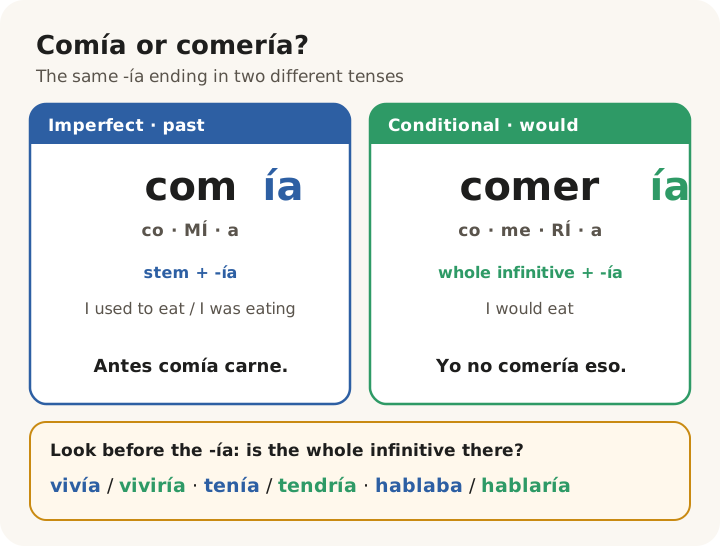
Antes comía carne.
I used to eat meat.
Yo no comería eso.
I wouldn't eat that.
Irregular stems: the same 12 as the future
The conditional borrows its irregular stems from the future, so these twelve are the whole list: tendría, pondría, saldría, vendría, valdría · podría, sabría, querría, habría, cabría · diría, haría. Why they shorten, and the three groups that make them easy to remember, are in the Spanish future tense lesson.
Even the irregulars keep it short: in the conditional tense, Spanish conjugation only changes the stem. The endings don’t move:
| Person | tener | poder | hacer | decir |
|---|---|---|---|---|
| yo | tendría | podría | haría | diría |
| tú / vos | tendrías | podrías | harías | dirías |
| él, ella, usted | tendría | podría | haría | diría |
| nosotros | tendríamos | podríamos | haríamos | diríamos |
| vosotros (Spain) | tendríais | podríais | haríais | diríais |
| ellos, ellas, ustedes | tendrían | podrían | harían | dirían |
And hay becomes habría, always singular: habría más gente, never “habrían.”
When to use the conditional tense
The conditional tense has five everyday jobs. Each one has an English cue, and most of them involve would, could or should.
- Polite requests and wishes, with me gustaría or podría.
- Advice, with deberías (“you should”) or yo en tu lugar (“if I were you”).
- Hypotheses: what would happen in another situation.
- The future seen from the past, after a verb like dijo or pensé.
- A guess about the past, the way the future guesses about the present: serían las diez is “it was probably ten” (NGLE §23.15j).

¿Podría hablar más despacio, por favor?
Could you speak more slowly, please?
Deberías dormir más.
You should sleep more.
Yo en tu lugar, hablaría con ella.
If I were you, I'd talk to her.
Con más tiempo, aprendería a cocinar.
With more time, I'd learn to cook.
Dijo que vendría a las ocho.
She said she would come at eight.
Serían las diez cuando llegó.
It was probably ten when he arrived.
The verbs you’ll use most in the conditional are poder, deber and gustar. Learn podría, debería and me gustaría as chunks and you’ve covered most polite Spanish.
Polite Spanish, one step at a time
Here’s the same request, from blunt to very polite. All four are correct; the conditional is what lifts the last two.
Quiero la cuenta.
I want the check.
¿Me trae la cuenta?
Can you bring me the check?
¿Me podría traer la cuenta?
Could you bring me the check?
Me gustaría pedir la cuenta, por favor.
I'd like to ask for the check, please.
These use usted (trae, podría), the usual choice with a waiter or a stranger in most of Latin America. You’ll also hear quisiera (Quisiera la cuenta), from the imperfect subjunctive. With querer, poder and deber, the Real Academia’s grammar says the two forms can alternate (NGLE §23.15u), as long as it’s the -ra form: “quisiese la cuenta” doesn’t work.
Not every “would” is a conditional
English would does several jobs, and only one of them is the Spanish conditional. Ask what the would means before you reach for -ía.
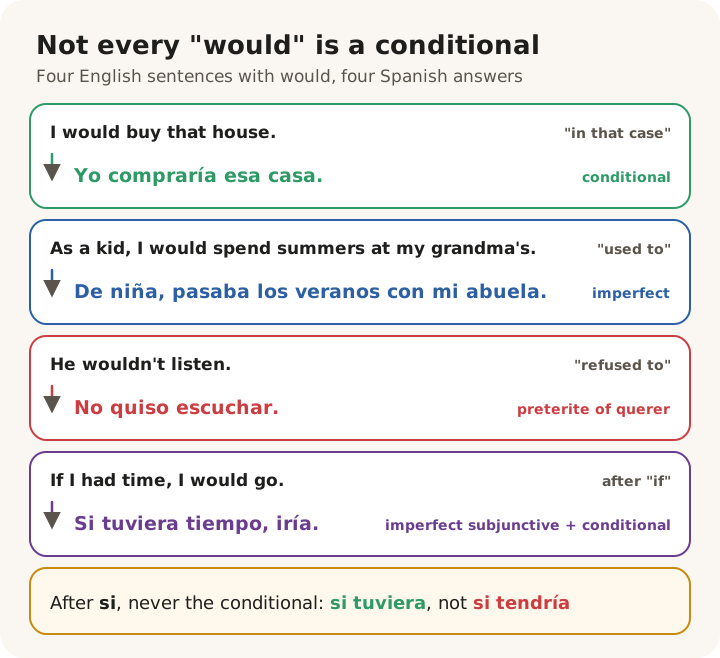
De niña, pasaba los veranos con mi abuela.
As a kid, I would spend summers at my grandma's.
No quiso escuchar.
He wouldn't listen.
Si viviera cerca, te visitaría más.
If I lived nearby, I'd visit you more.
A quick test for the first trap: if you can swap would for used to, it’s the imperfect. The second one, no quiso, is one of the verbs that change meaning in the preterite, covered in preterite vs imperfect.
After si, never the conditional
The conditional goes in the “then” half. After si, Spanish uses the imperfect subjunctive: Si tuviera dinero, te prestaría, not “si tendría dinero.” The forms of tuviera and viviera have their own section on the imperfect subjunctive practice page.
Conditional or future?
Same build, same twelve stems, so the two are easy to mix up. The future looks forward from now; the conditional looks forward from the past, or into a “what if.”
| Future | Conditional |
|---|---|
| hablaré: I will speak | hablaría: I would speak |
| Serán las tres. It’s probably three (now). | Serían las diez. It was probably ten (then). |
| Dice que vendrá. She says she’ll come. | Dijo que vendría. She said she would come. |
Tocan la puerta. ¿Quién será?
Someone's knocking. Who could it be?
Alguien llamó anoche. ¿Quién sería?
Someone called last night. Who could it have been?
How native speakers use the conditional
Four clips from Easy Spanish videos, with speakers from Mexico and Colombia. The first two are the polite conditional in action.

- Oigan, ¿les podría hacer una entrevista de dos minutos?Excuse me, could I do a two-minute interview with you? · Easy Spanish · Mexico
- Ahora me gustaría saber un poco acerca de su historia.Now I'd like to know a little about your story. · Easy Spanish · Mexicans in Berlin
- Yo si fuera tú, cambiaría de ruta.If I were you, I'd change routes. · Super Easy Spanish · Colombia
- O si no tuvieras que trabajar, ¿qué harías?Or if you didn't have to work, what would you do? · Easy Spanish · Mexico
The last two show the if pattern from above: si fuera, si no tuvieras in the first half, the conditional in the second.
Frequently asked questions
Is the conditional a tense or a mood?
It’s a tense of the indicative. Grammarians have long argued about it, and the view generally accepted today, the one in the Real Academia’s grammar, is that it’s a tense. Part of the reason: it shows up where the indicative does (Prometió que iría) and never where the subjunctive is required (NGLE §23.15a).
Querría or quisiera?
Both are correct for “I’d like.” In a request, quisiera is the more common one, and it avoids a listening problem: spoken fast, querría (“I would want”) sounds a lot like quería (“I wanted”). And me gustaría works everywhere.
How do you say “would have” in Spanish?
Use habría plus the past participle: habría ido, “I would have gone.” That compound form gets a short section in the Spanish present perfect lesson, next to the other tenses built with haber.
Is “si tendría” ever correct?
Not in standard Spanish. The Real Academia records it in casual speech in parts of Argentina, Uruguay, Paraguay, the Andes, Chile, southern Colombia and northern Spain, and recommends avoiding it (NGLE §23.15d). You may hear it, but don’t write it: si tuviera.
Try the conditional: six sentences
Choose the right form. After each answer you’ll see why.
The conditional tense
0 of 6¿Me ___ decir la hora, por favor? (poder, usted)
Yo en tu lugar, no ___ con esta lluvia. (salir)
De niño, mi hermano ___ en la calle todos los días. (jugar)
Si ___, te ayudaría. (poder)
Mis papás dijeron que ___ tarde. (llegar)
—¿Cuántos años tenía? —No sé, ___ unos veinte. (tener)
For more, the Spanish future tense practice page mixes in a few conditional sentences with audio and has a printable worksheet, and the conjugation trainer set to the conditional drills any of the 150 most common verbs.
Two roads lead on from here. The si tuviera half of the if sentence is the imperfect subjunctive, and would have (habría ido) lives with the compound tenses in the present perfect.

Spanish teacher · B.A. in Spanish (UnB) · 10+ years teaching
Spanish teacher with a degree in Spanish from the University of Brasília (UnB) and more than 10 years teaching.