On this page
In this post
- How to conjugate -ir verbs, with vivir as the model
- The five forms where -er and -ir verbs split
- The endings in four tenses, and 35 common -ir verbs
- The -ir verbs that only look regular
Spanish -ir verbs, like vivir (to live), use the same endings as -er verbs almost everywhere, and you can hear the difference in just one everyday word: comemos (we eat) but vivimos (we live). Of the 710 verbs in our Spanish conjugator, 119 end in -ir, exactly as many as end in -er. So if you already know comer, this group costs you five forms, not a whole new table.
Comemos juntos los domingos.
We eat together on Sundays.
Vivimos a dos cuadras.
We live two blocks away.
If you’ve worked through -ar verbs, the method is the one you already use: stem plus ending. Here we build everything on vivir, find the five spots where it parts ways with comer, run it through four tenses and end with 35 -ir verbs you’ll actually say. For the big picture of all three groups, see Spanish verbs.
How to conjugate Spanish -ir verbs: drop -ir, add the ending
To conjugate -ir verbs, drop the -ir from the infinitive and add an ending that tells who is acting and when. Vivir leaves the stem viv-. Add -o and you get vivo, “I live.” Add -imos and you get vivimos, “we live.” The stem holds the meaning; the ending carries the person and the tense.

The Real Academia Española uses partir as the model verb for this group in its conjugation tables. We use vivir because you’ll need it sooner, in your first conversation about where you live. The pattern is identical.
Here are the -ir Spanish verb endings in the present tense:
| Person | Ending | vivir |
|---|---|---|
| yo | -o | vivo |
| tú | -es | vives |
| vos | -ís | vivís |
| él, ella, usted | -e | vive |
| nosotros | -imos | vivimos |
| vosotros (Spain) | -ís | vivís |
| ellos, ellas, ustedes | -en | viven |
In Argentina, Uruguay and much of Central America, vos replaces tú: vos vivís. Vosotros is the plural “you” of Spain; in Latin America the plural is ustedes viven. With -ir verbs, vos and vosotros happen to share the same form.
¿Dónde vives?
Where do you live?
Recibo muchos correos cada día.
I get a lot of emails every day.
Escribimos muchos mensajes.
We write a lot of messages.
-ir verbs vs the verb ir
An “-ir verb” is simply a verb with an infinitive that ends in those two letters. Ir (to go) is one single verb, and a wildly irregular one: voy, vas, va. It has its own page, ir conjugation, and none of what follows applies to it.
-er and -ir Spanish verbs: where they split
Put comer next to vivir and most forms match, ending for ending. The -er and -ir Spanish verbs part ways in only five places. Every one of them involves nosotros, vosotros or vos:
| Form | comer (-er) | vivir (-ir) |
|---|---|---|
| nosotros, present | comemos | vivimos |
| vosotros, present (Spain) | coméis | vivís |
| vos, present | comés | vivís |
| vosotros command (Spain) | comed | vivid |
| vos command | comé | viví |
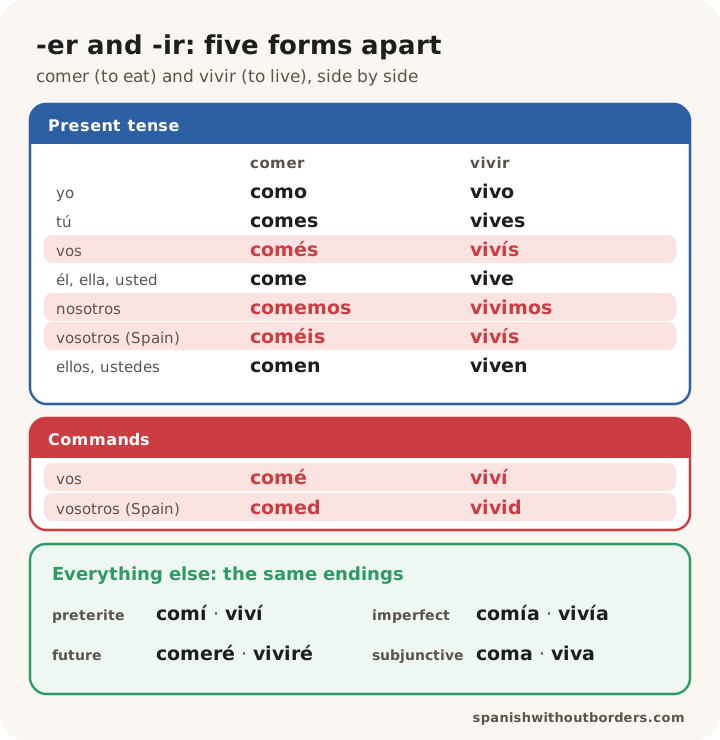
Everything else lines up: comí / viví in the preterite, comía / vivía in the imperfect, comeré / viviré in the future, coma / viva in the present subjunctive. That’s why most textbooks teach -er and -ir Spanish verbs together and then add a footnote. The footnote is the table above.
If you speak with Argentines or Uruguayans, you’ll hear the vos form constantly:
¿Dónde vivís?
Where do you live?
The trap for English speakers is vivemos. It looks reasonable, since comemos exists, but it isn’t Spanish. The -ir group keeps its i in nosotros: vivimos, escribimos, recibimos.
-ir verbs in the past and the future
Preterite. For actions that happened and finished, -ir verbs take exactly the -er endings: viví, viviste, vivió, vivimos, vivisteis, vivieron. The accent marks on viví and vivió matter; they put the stress on the last syllable. When to choose this tense is covered in the Spanish preterite tense.
Imperfect. For background and “used to,” the endings are -ía with an accent mark on the í in every person: vivía, vivías, vivíamos. Same as -er again. The imperfect in Spanish explains when it beats the preterite.
Future. Keep the whole infinitive and add the ending: vivir + -é = viviré. These future endings are shared by all three groups, so there’s nothing new to learn.
¿Recibiste mi mensaje?
Did you get my message?
De niño, vivía en Lima.
As a kid, I lived in Lima.
¿Compartimos un taxi?
Shall we share a taxi?
Mañana escribiré el informe.
I'll write the report tomorrow.
-ir Spanish verb endings in one chart
These are the -ir Spanish verb endings in the four tenses you’ll meet first, all on vivir. The three forms in bold are the only cells where an -er verb would look different; every other cell has the same ending you’d use with comer.
| Person | Present | Preterite | Imperfect | Future |
|---|---|---|---|---|
| yo | vivo | viví | vivía | viviré |
| tú | vives | viviste | vivías | vivirás |
| vos | vivís | viviste | vivías | vivirás |
| él, ella, usted | vive | vivió | vivía | vivirá |
| nosotros | vivimos | vivimos | vivíamos | viviremos |
| vosotros (Spain) | vivís | vivisteis | vivíais | viviréis |
| ellos, ellas, ustedes | viven | vivieron | vivían | vivirán |
Look at nosotros: vivimos means both “we live” and “we lived.” With -er verbs the two are different (comemos, comimos), so this is one place where the -ir group is easier than the -er group. Context tells you which one you’re hearing.
Every form of this chart has audio on the vivir conjugation page, and vivir is one of the verbs in our printable verb tables.
35 common -ir verbs
Here are 35 regular Spanish -ir verbs, sorted by topic. Each one follows the conjugation pattern of vivir in every simple tense. A linked verb opens a page where you can hear every form and see it in a sentence; the others still conjugate in the conjugator, they just don’t have their full write-up yet. Verbs marked † break the pattern in one form only, the past participle: escrito, descrito, abierto, cubierto, descubierto, impreso (imprimido is also correct).
Life and home
| Verb | Meaning | Yo, present | Yo, preterite |
|---|---|---|---|
| vivir | to live | vivo | viví |
| compartir | to share | comparto | compartí |
| subir | to go up, to upload | subo | subí |
| abrir† | to open | abro | abrí |
| cubrir† | to cover | cubro | cubrí |
| sufrir | to suffer | sufro | sufrí |
| existir | to exist | existo | existí |
| unir | to join, to unite | uno | uní |
| dividir | to divide, to split | divido | dividí |
Words and paper
| Verb | Meaning | Yo, present | Yo, preterite |
|---|---|---|---|
| escribir† | to write | escribo | escribí |
| describir† | to describe | describo | describí |
| imprimir† | to print | imprimo | imprimí |
| discutir | to argue, to discuss | discuto | discutí |
| debatir | to debate | debato | debatí |
| insistir | to insist | insisto | insistí |
| admitir | to admit | admito | admití |
| añadir | to add | añado | añadí |
| interrumpir | to interrupt | interrumpo | interrumpí |
Getting and giving
| Verb | Meaning | Yo, present | Yo, preterite |
|---|---|---|---|
| recibir | to receive, to get | recibo | recibí |
| permitir | to allow | permito | permití |
| repartir | to hand out, to deliver | reparto | repartí |
| consumir | to consume | consumo | consumí |
| descubrir† | to discover | descubro | descubrí |
| resistir | to resist, to hold up | resisto | resistí |
Things that happen
| Verb | Meaning | Yo, present | Yo, preterite |
|---|---|---|---|
| decidir | to decide | decido | decidí |
| ocurrir | to happen | ocurro | ocurrí |
| cumplir | to keep (a promise), to turn (an age) | cumplo | cumplí |
| partir | to leave, to split | parto | partí |
| asistir | to attend | asisto | asistí |
| coincidir | to coincide, to agree | coincido | coincidí |
| aburrir | to bore | aburro | aburrí |
| sobrevivir | to survive | sobrevivo | sobreviví |
| confundir | to confuse | confundo | confundí |
| acudir | to go, to turn up | acudo | acudí |
| sacudir | to shake | sacudo | sacudí |
Two notes from the list. Discutir usually means “to argue” in everyday Latin American Spanish, not a calm discussion. And cumplir is the verb for birthdays: Mañana cumplo treinta is “I turn thirty tomorrow.”
-ir verbs that look regular but aren’t
An -ir ending doesn’t promise a regular verb. Of the 119 Spanish -ir verbs in our conjugator, 43 are regular in every simple tense, 18 just adjust their spelling, 42 change their stem vowel and 16 are irregular in other ways. Here’s the map, without full tables. Each group has its own lesson.
| Group | Examples | What happens | Where to learn it |
|---|---|---|---|
| e → ie | sentir, preferir, mentir | siento, prefiero, miento | stem changing verbs |
| e → i (only -ir) | pedir, servir, repetir, seguir, vestir | pido, sirvo, repito, sigo, visto | stem changing verbs |
| o → ue | dormir, morir | duermo, muero | stem changing verbs |
| -uir adds a y | construir, incluir | construyo, incluyo | irregular verbs |
| -gir: g becomes j | dirigir, elegir | dirijo, elijo | irregular verbs |
| yo ends in -go or -zco | salir, venir, decir, conducir | salgo, vengo, digo, conduzco | irregular verbs |
| a class of their own | oír, reír, ir | oigo, río, voy | each verb’s page |
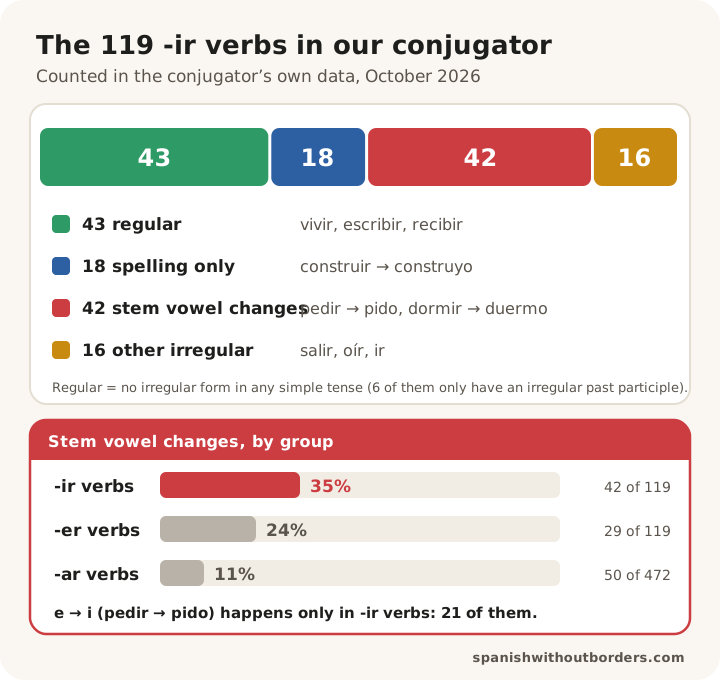
The stem change is the signature of this group. It hits 35% of -ir verbs, against 24% of -er verbs and 11% of -ar verbs. One kind, e → i, exists only here: 21 verbs, from pedir to seguir to decir. Stem changing -ir verbs also carry a smaller change into the preterite, which Spanish stem changing verbs walks through form by form.
Check yourself: -ir verbs
Pick the right form: it’s the quickest way to see if you can conjugate -ir verbs without looking at the chart. Some wrong answers borrow an -er ending on purpose.
-ir verbs: quick check
0 of 7Nosotros ___ cartas a mano. (escribir)
Vos siempre ___ visitas los domingos. (recibir)
Vosotros ___ en Madrid, ¿no? (vivir · Spain)
Ayer el precio de la gasolina ___. (subir)
Cuando éramos chicos, mi hermano y yo ___ el cuarto. (compartir)
Mañana ___ qué hacer. (decidir, yo)
Siempre ___ lo mismo en este restaurante. (pedir, yo)
For more sentences with audio, the regular verbs exercises mix all three groups in the present and the past. To drill one verb until it’s automatic, open the conjugation trainer with vivir or switch it to escribir.
Frequently asked questions
Are -ir verbs the same as -er verbs?
Almost. They share every ending except five forms. Three are in the present: vivimos, vivís (vosotros) and vivís (vos), against comemos, coméis and comés. The other two are the commands viví and vivid, against comé and comed.
Is escribir a regular verb?
Yes, in every simple tense: escribo, escribí, escribía, escribiré. Only the past participle is irregular: he escrito (I have written), never escribido.
Which -ir verbs should I learn first?
Start with vivir, escribir, abrir, recibir and subir. They’re regular, you’ll use them in your first weeks, and each one has its own page in our conjugator, where you can hear every form. Then add decidir and compartir.
Is ir an -ir verb?
Technically its infinitive ends in -ir, but it doesn’t follow the pattern at all: voy, fui, iba. Learn it on its own with the ir conjugation page.
About a third of all -ir verbs change their stem vowel, and the Spanish stem changing verbs lesson is where that story continues.

Spanish teacher · B.A. in Spanish (UnB) · 10+ years teaching
Spanish teacher with a degree in Spanish from the University of Brasília (UnB) and more than 10 years teaching.