
On this page
In this post
- Lo, la, los or las: let the Spanish noun decide
- Where the pronoun goes, and the accent it brings
- The personal a, and the verbs that drop for and to
- Lo or le, and which pronoun you need when
Spanish direct object pronouns are the short words that stand in for the thing or person a verb acts on: in lo hago, “I do it,” lo is the “it.” Here’s one from a street interview in Mexico City, about breakfast:

Los stands for los chilaquiles, a Mexican breakfast dish. Notice the two things English speakers miss: the pronoun copies the Spanish word it replaces, and it comes before the verb.
What Spanish direct object pronouns replace
What are direct objects? The nouns that receive the action: the book you have, the friend you call. A direct object pronoun replaces that noun so you don’t say it twice.
¿Tienes el libro? Sí, lo tengo.
Do you have the book? Yes, I have it.
How to find the direct object in Spanish
The direct object, Spanish or English, answers “what?” or “whom?” right after the verb. I have… what? The book. I call… whom? My mom.
The trap is a group of verbs that need a preposition in English and none in Spanish. Buscar already means “look for,” so what you’re looking for is a plain direct object. Spanish adds nothing:
| English | Spanish | With a pronoun |
|---|---|---|
| look for | buscar | La busco. |
| wait for | esperar | Lo espero. |
| listen to | escuchar | Te escucho. |
| look at | mirar | Las miro. |
So it’s estoy buscándolas, never buscando por ellas. Each verb has its own page: buscar, esperar, escuchar, mirar.
¿Las llaves? Estoy buscándolas.
The keys? I'm looking for them.
The forms: me, te, lo, la, nos, los, las
| Who or what | Pronoun | English |
|---|---|---|
| yo | me | me |
| tú, vos | te | you (informal) |
| él, usted (man), a masculine noun | lo | him, it, you (formal) |
| ella, usted (woman), a feminine noun | la | her, it, you (formal) |
| nosotros, nosotras | nos | us |
| masculine or mixed plural, ustedes | los | them, you all |
| feminine plural, ustedes (all women) | las | them, you all |
Spain adds os for vosotros (os veo mañana). Me, te and nos look like the reflexive pronouns: mi mamá me llama is a direct object, me lavo is reflexive (Spanish reflexive verbs).
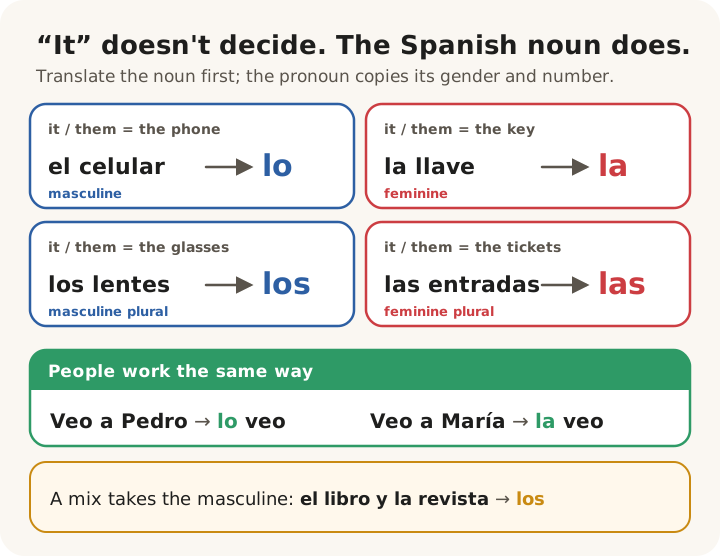
English uses “it” for everything. Spanish copies the gender and number of the noun: masculine singular takes lo, feminine plural takes las, and a mix takes los.
Mi mamá me llama todos los días.
My mom calls me every day.
Nuestros abuelos nos visitan cada domingo.
Our grandparents visit us every Sunday.
¿Conoces a Lucía? Sí, la conozco desde hace años.
Do you know Lucía? Yes, I've known her for years.
Lo and la for usted
Usted takes lo for a man and la for a woman, so lo can mean “him” or “you.” Context sorts it out: Señora, la llamo mañana is “Ma’am, I’ll call you tomorrow.”
Señor, lo espero aquí.
Sir, I'll wait for you here.
Neuter lo: no lo sé
Lo can also stand for an idea, with no noun behind it: no lo sé (I don’t know), ya lo sé (I know), lo digo (I say so). This lo never changes.
No lo sé.
I don't know.

Where the direct object pronoun goes
English puts “it” after the verb. Spanish usually puts it before:
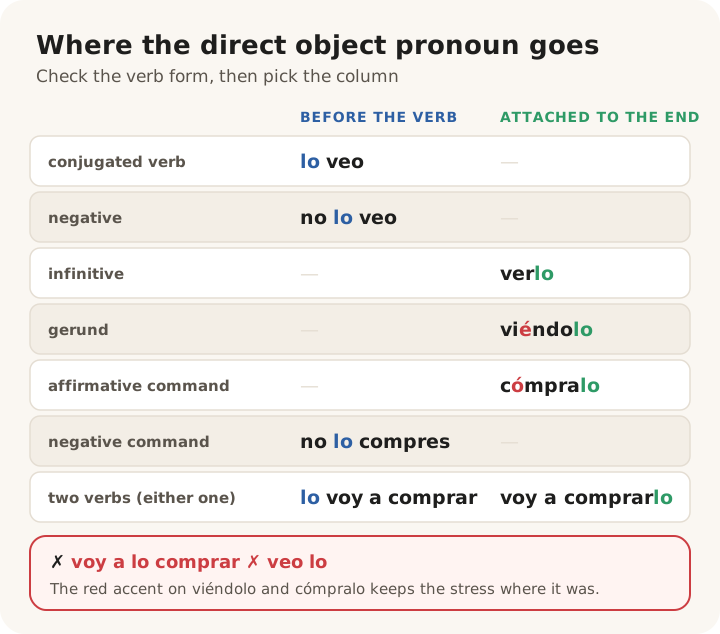
- Before a conjugated verb: lo veo, no lo veo.
- Attached to an infinitive, a gerund or an affirmative command: verlo, viéndolo, ¡cómpralo!
- Two verbs together, you choose: lo voy a comprar or voy a comprarlo.
- Negative command, back in front: no lo compres.
The stress stays where it was, so the gerund and the command pick up a written accent (viéndolo, cómpralo); the infinitive doesn’t (comprarlo). Same rules in the RAE’s guide to unstressed pronouns.
¿Dónde está mi celular? No lo encuentro.
Where's my phone? I can't find it.
¿El boleto? Voy a comprarlo mañana.
The ticket? I'm going to buy it tomorrow.
¿La tarea? La estoy haciendo ahora.
The homework? I'm doing it now.
In Mexico City, a question about tortillas uses the infinitive spot twice:

Placement takes the most repetition, and the direct object pronouns practice page drills it with audio.
The personal a: when the direct object is a person
When the direct object is a specific person, Spanish puts a in front of it: veo a mi abuela. That a has no English translation, and it disappears when the pronoun comes in: la veo.
| Personal a | No personal a |
|---|---|
| a specific person: Veo a María. | a thing: Veo la casa. |
| a person you know: Busco a mi médico. | any person: Busco un médico. |
| a pet: Busco a mi perro. | with tener: Tengo dos hermanos. |
Pets get the a because you feel close to them, as the RAE’s entry on the preposition a explains.
Veo a mi abuela los domingos.
I see my grandmother on Sundays.
La veo los domingos.
I see her on Sundays.
Busco un médico.
I'm looking for a doctor.
Busco a mi médico.
I'm looking for my doctor.
Direct object pronoun Spanish examples from native speakers
Three more direct object pronoun Spanish examples, from Mexico City and Barcelona:

- Si hubiera cerca de mi casa, seguro que la utilizaría.If there were one near my house, I'd definitely use it. · Easy Spanish · Mexico City
- Únicamente los veo cuando subimos y bajamos de los pisos.I only see them when we're going up or down in the building. · Easy Spanish · Barcelona, Spain
- Total, México ya lo conozco.Anyway, I already know Mexico. · Easy Spanish · Mexico City
La is la Ecobici, Mexico City’s shared bike: English says “it,” Spanish says la. Los is los vecinos, the neighbors. And when the object opens the sentence (México), Spanish repeats it with a pronoun: México ya lo conozco.
Quick check: lo, la, los or las?
Direct object pronouns
0 of 6¿Tienes la mochila? Sí, ___ tengo aquí.
¿Compraste el libro y la revista? Sí, ___ compré.
No encuentro el pasaporte. ___ desde ayer.
¿El libro? Estoy ___ ahora.
¿La ventana? ¡___, por favor!
Conozco ___ tu hermana.
For 20 more sentences with audio, plus le and se lo, go to the direct object pronouns practice.
Lo, le or se? Which pronoun you need
Each small pronoun next to the verb answers a different question:
| Ask | Pronoun | Example | Lesson |
|---|---|---|---|
| what? whom? | lo, la, los, las | Lo vi ayer. | this one |
| to whom? for whom? | le, les | Le escribí. | indirect pronouns (gustar already uses them) |
| both at once | se lo, se la | Se lo di. | combining pronouns |
| back to the subject? | me, te, se | Me lavo. | reflexive verbs |
Lo or le?
In Spain you’ll hear le vi for “I saw him.” This is leísmo, and the RAE’s entry on leísmo accepts it when le refers to a man (far more often in the singular), but not for a woman or a thing. Latin America says lo vi, and lo is correct everywhere, so use lo.
Lo vi ayer.
I saw him yesterday.
Le vi ayer.
I saw him yesterday.
Unsure? Ask the question after the verb. “What?” or “whom?” points to lo, la, los, las, and the Spanish noun picks which one.

Spanish teacher · B.A. in Spanish (UnB) · 10+ years teaching
Spanish teacher with a degree in Spanish from the University of Brasília (UnB) and more than 10 years teaching.

