

On this page
In this post
- A 20-second check to find the right level
- The three-pass routine for any text
- Four texts with audio and questions, A1 to B1
- When to come back to the same text
Spanish reading practice works best at the right level, so start with a 20-second check. Read these two sentences out loud, then play them:
Los domingos, mi abuela prepara tamales y toda la familia llega temprano.
Mi hermano siempre trae el pan, pero esta semana se le olvidó.
How many words did you have to look up? The usual suspects are tamales (corn dough steamed in a husk), trae (brings, from traer) and se le olvidó (he forgot). In English: “On Sundays, my grandma makes tamales and the whole family gets there early. My brother always brings the bread, but this week he forgot.”
Spanish reading practice starts with the right level
Those two sentences have 24 words. One unknown word means you knew about 96% of the vocabulary, and that’s the zone where reading teaches you something without wearing you out. Three or more unknowns puts you under 90%, and there most readers lose the thread.
Those numbers come from vocabulary research with learners of English, in the open journal Reading in a Foreign Language. In Hu and Nation (2000), nobody understood a story well at 80% of the words; at 90% and 95% some did, but most didn’t, and about 98% was the bar for reading without help. Laufer and Ravenhorst-Kalovski (2010) agree: about 95% is the minimum for reading with some guidance, 98% for reading on your own.
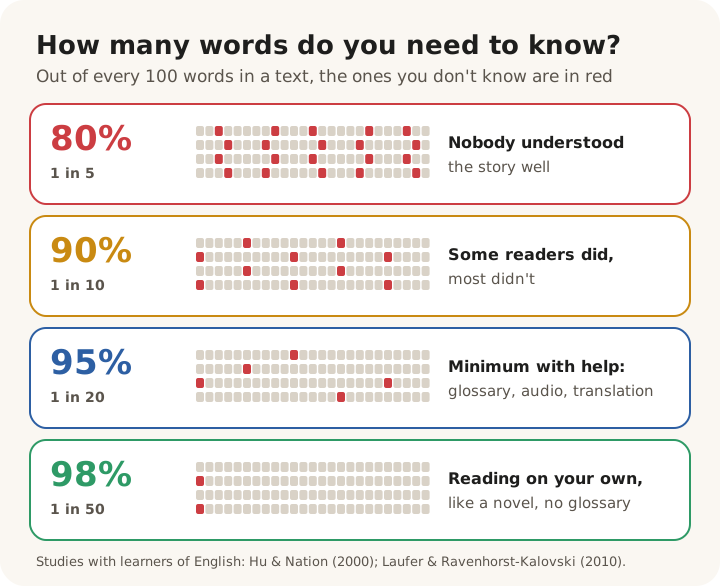
For the texts on this page you have help: audio, a glossary and a translation you can open. So aim for about 19 words in 20. A novel with no glossary needs 49 in 50. If you’re not sure which level to pick, the Spanish level test takes 5 to 15 minutes and gives you a separate result for reading.
How to read a Spanish text: three passes
This routine works with any text, here or anywhere else:
- Listen without reading. Catch the topic and who’s talking. Missing half of it is fine.
- Read along with the audio. Now sound and spelling meet. Slow it to 0.75× if the voice runs ahead.
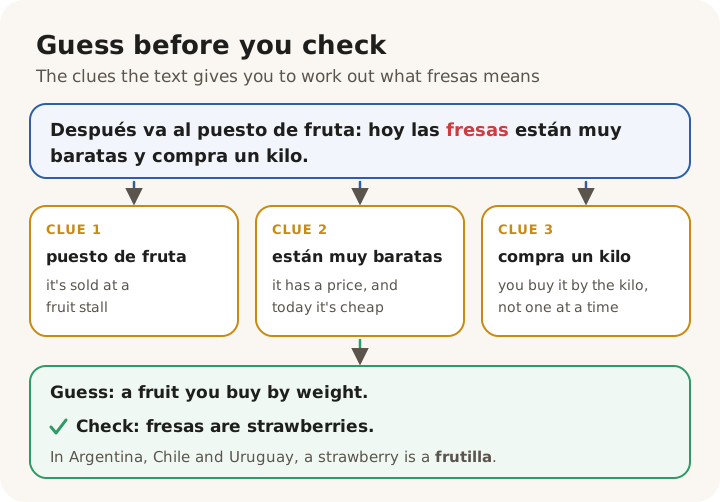
- Guess, then check. Before you open the translation, use what’s around the word: where the scene happens, what comes before and after, what people do with the thing. Then check. Write down five new words at most.
Here’s step 3 with a sentence from the market text below:
The most common mistake is translating every line: you end up reading English with Spanish words in the way. The second is always reading silently. Reading out loud, copying the audio, is the shortest bridge from reading to speaking.
Reading in Spanish for beginners: A1 texts
At A1, real life is short: a quick conversation, a note, a message. These two texts use the present tense and the words you’d need on day one. The first is about the time, so the telling time exercises are a good follow-up.
¿Qué hora es?
listenedLuna: Hola, Pablo. ¿Qué hora es?
Pablo: Son las dos y media.
Luna: Gracias. ¿Y a qué hora es la reunión?
Pablo: Es a las cuatro en punto.
Luna: Perfecto. Entonces tengo tiempo para comer.
Pablo: Sí, tienes tiempo de sobra. ¿Vamos juntos a la fonda de la esquina?
Luna: ¡Sí! Pero a un cuarto para las cuatro regresamos, ¿eh?
Pablo: De acuerdo. ¡Vamos!
Luna: Hi, Pablo. What time is it?
Pablo: It's two thirty.
Luna: Thanks. And what time is the meeting?
Pablo: It's at four o'clock sharp.
Luna: Perfect. Then I have time to eat.
Pablo: Yes, you have plenty of time. Shall we go to the little restaurant on the corner?
Luna: Yes! But we come back at a quarter to four, okay?
Pablo: Deal. Let's go!
¿Qué hora es?
0 of 3¿Qué hora es?
¿A qué hora es la reunión?
¿Adónde van Luna y Pablo?
The second text is a message, the kind you’d find on your phone after a long day.
Mensaje de Dani
listenedHola, Vale. Hoy llego tarde a la casa, como a las nueve, porque tengo clase de inglés. En la nevera hay arroz y pollo para la cena. Por favor, saca la basura: el camión pasa mañana a las seis de la mañana. Ah, y si llama mi mamá, dile que la llamo el sábado. ¡Gracias! Un abrazo, Dani.
Hi, Vale. I'll be home late today, around nine, because I have English class. There's rice and chicken in the fridge for dinner. Please take out the trash: the truck comes tomorrow at six in the morning. Oh, and if my mom calls, tell her I'll call her on Saturday. Thanks! Hugs, Dani.
Mensaje de Dani
0 of 3¿A qué hora llega Dani a la casa?
¿Qué hay en la nevera?
¿Cuándo pasa el camión de la basura?
Spanish reading exercises for A2
These Spanish reading exercises add a paragraph’s worth of story: one person, one morning, a few places. Try the three passes on it before you look at the quiz.

El mercado de los sábados
listenedTodos los sábados, Mariana va al tianguis de su colonia, en la Ciudad de México. Sale de casa a las nueve, con una bolsa grande y una lista pequeña.
Primero compra pan dulce en el puesto de don Julio, que siempre le cuenta un chiste. Después va al puesto de fruta: hoy las fresas están muy baratas y compra un kilo.
En el puesto de pescado hay mucha gente, así que espera su turno y platica con una vecina. Al final, Mariana se sienta en un puesto de jugos y pide un jugo de naranja.
Le gusta mirar a la gente y escuchar las conversaciones. Para ella, el sábado en el tianguis es el mejor momento de la semana.
Every Saturday, Mariana goes to the street market in her neighborhood, in Mexico City. She leaves home at nine, with a big bag and a small list.
First she buys sweet bread at don Julio's stall, and he always tells her a joke. Then she goes to the fruit stall: today strawberries are really cheap, so she buys a kilo.
There are lots of people at the fish stall, so she waits her turn and chats with a neighbor. At the end, Mariana sits down at a juice stand and orders an orange juice.
She likes watching people and listening to their conversations. For her, Saturday at the market is the best part of the week.
El mercado de los sábados
0 of 5¿Qué día va Mariana al tianguis?
¿Qué hace don Julio?
¿Por qué Mariana espera en el puesto de pescado?
¿Qué significa "platicar"?
¿Qué pide Mariana al final?
Questions like these are the core of Spanish reading comprehension practice: answer from memory first, then go back to the text only to check. Two verbs carry most of the story, comprar and pedir (pide has the e → i change), and the food exercises cover the market words.
B1 reading: longer texts, same routine
At B1 a text can describe instead of just telling: a city, a dish, why a place feels the way it does. The sentences get longer, and the routine stays the same.
Oaxaca, una ciudad para caminar
listenedOaxaca de Juárez es una ciudad pequeña del sur de México, rodeada de montañas. El centro se recorre a pie sin problema: muchas calles son de piedra y las casas están pintadas de colores fuertes.
El corazón de la ciudad es el zócalo, una plaza con árboles enormes donde la gente se sienta a conversar o a leer el periódico. A dos cuadras está el mercado 20 de Noviembre, famoso por su pasillo de carnes asadas: uno elige la carne, la cocinan ahí mismo y se come con tortillas.
La comida es una de las razones principales para visitar Oaxaca. Por algo la llaman la tierra de los siete moles, unas salsas espesas que se preparan con chiles, especias y, a veces, chocolate.
Lo que más recuerdan los visitantes, sin embargo, es el ritmo: muchos dicen que aquí el tiempo pasa más despacio.
Oaxaca de Juárez is a small city in southern Mexico, surrounded by mountains. You can get around the center on foot with no trouble: many streets are made of stone and the houses are painted in bright colors.
The heart of the city is the zócalo, a square with huge trees where people sit to talk or read the paper. Two blocks away is the 20 de Noviembre market, famous for its grilled meat aisle: you choose the meat, they cook it right there, and you eat it with tortillas.
Food is one of the main reasons to visit Oaxaca. There's a reason it's called the land of the seven moles, thick sauces made with chiles, spices and sometimes chocolate.
What visitors remember most, though, is the pace: many say time goes by more slowly here.
Oaxaca, una ciudad para caminar
0 of 4¿Cómo se recorre el centro de Oaxaca?
¿Qué es el zócalo?
¿Con qué se preparan los moles?
¿Qué recuerdan más los visitantes?
The se in se recorre, se come and se preparan is the general “you”: no one in particular does it. Guidebooks and recipes are full of it.
Come back to the same text
One text read four times beats four texts read once. Each visit is short, and each one has its own job:
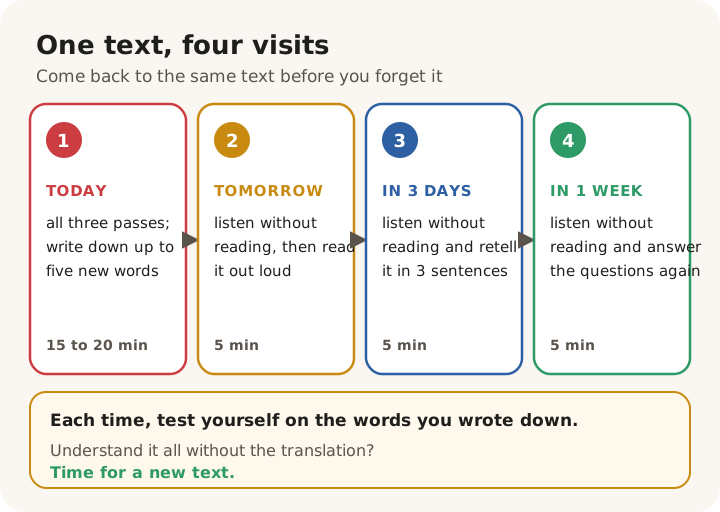
The retelling on day three is where reading turns into speaking: three sentences in your own words, out loud, without looking. Pick one text from this page today and come back to it tomorrow.
When these feel easy, move on to longer narratives. The Spanish short stories on this site go from A1 to B1, each with audio and a quiz, and they use the same three passes. After that, subtitles on a show you already know and news written in easy Spanish are good next steps.
Frequently asked questions
Do I need to understand every word?
No. Aim for about 19 words in 20 when you have help, and make sure you get the idea of each sentence. Write down five new words at most, the ones that block a sentence or keep coming back, and leave the rest for the next visit.
How long should I practice reading Spanish each day?
Fifteen minutes of Spanish reading practice a day does more than two hours once a week. One short text with all three passes is enough for a first day, and each return visit takes about five minutes.
Can I practice reading without audio?
Yes, but you lose the first two passes, the ones that train your ear. Read out loud anyway. When you’re starting out, choose texts with audio, like the ones on this page.
Should I translate the text into English?
Only the words that block a sentence. Translating line by line makes reading slow and keeps you thinking in English. Use the translation to check a guess, not to replace the Spanish.
Why is reading practice important in Spanish?
Reading is where you meet vocabulary in context, many times, at your own speed. That’s how new words stick. Reading in Spanish for beginners should feel a little hard, but never leave you lost: if you need the translation for almost every sentence, pick an easier text. And Spanish reading comprehension practice with questions shows you what you actually understood.

Spanish teacher · B.A. in Spanish (UnB) · 10+ years teaching
Spanish teacher with a degree in Spanish from the University of Brasília (UnB) and more than 10 years teaching.
