
On this page
In this post
- A keyboard on the page to copy á, é, ñ, ¿ and ¡
- Shortcuts for Windows, Mac, Chromebook, iPhone and Android
- The 3 rules for accent marks, with audio
- The accents that change meaning: tú, tu, sí, si, qué, que
Spanish accents come in two parts: typing them and knowing when a word needs one.
Spanish accent keyboard
Tap a letter and you’ll see how to type it yourself next time.
Select a letter, copy it and paste it where you’re typing: á é í ó ú ü ñ ¿ ¡ Á É Í Ó Ú Ü Ñ
Need an é right now? Tap it on the Spanish accent keyboard above, copy, and paste it wherever you’re writing. Each letter you tap also shows its shortcut, so next time you can type it yourself. Below are the shortcuts for every system, then the three rules for which words take a mark, with audio.
How to type Spanish accents on any device
Spanish has five accented vowels plus ü, one extra letter and two upside-down marks. Here’s how to type Spanish accents on each system.
| Character | Windows (Alt code) | Windows (US-International) | Mac | iPhone and Android |
|---|---|---|---|---|
| á | Alt + 0225 | ’ then a | Option + e, then a | hold a |
| é | Alt + 0233 | ’ then e | Option + e, then e | hold e |
| í | Alt + 0237 | ’ then i | Option + e, then i | hold i |
| ó | Alt + 0243 | ’ then o | Option + e, then o | hold o |
| ú | Alt + 0250 | ’ then u | Option + e, then u | hold u |
| ü | Alt + 0252 | ” then u | Option + u, then u | hold u |
| ñ | Alt + 0241 | AltGr + n, or ~ then n | Option + n, then n | hold n |
| ¿ | Alt + 0191 | AltGr + / | Option + Shift + ? | hold ? |
| ¡ | Alt + 0161 | AltGr + 1 | Option + 1 | hold ! |
AltGr is the right-hand Alt key. The card below has the Alt codes for capitals; on a Mac, add Shift to the letter.

Spanish accents on letters: á, é, í, ó, ú, ü and ñ
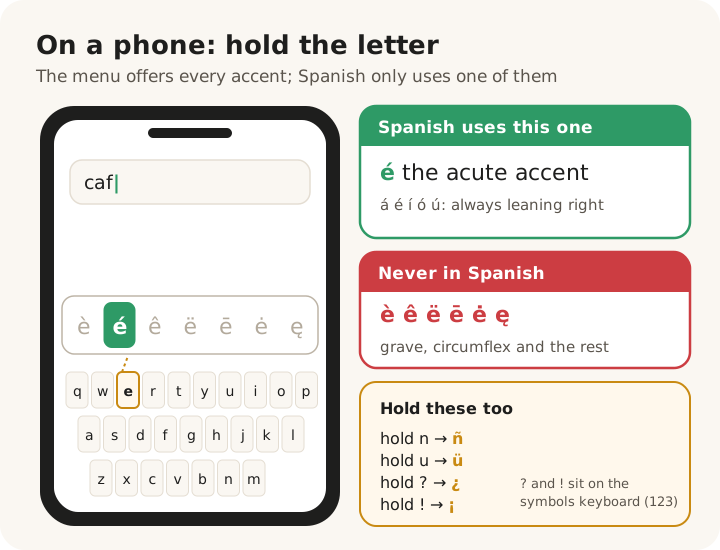
All Spanish accents on letters are the same mark, the acute accent, leaning right: á, é, í, ó, ú. Never à or â. The two dots on ü only show up in güe and güi, to tell you the u is pronounced. And ñ isn’t an n with an accent: it’s its own letter, right after n in the dictionary (the alphabet exercises drill it). Capitals keep their marks: Ángel.
pingüino
penguin
año
year
Ángel
Ángel (a name)
Windows: Alt codes, US-International, and Word’s Ctrl shortcut
- Alt codes. Hold Alt, type the four digits on the number pad with Num Lock on, then let go. The number row won’t work, so most laptops are out (Microsoft’s code list).
- US-International keyboard. The apostrophe waits for the next key: ’ then e gives é. The catch: for a plain apostrophe before a vowel in English, press the space bar after it.
- Word and Outlook. Ctrl + ’ then the vowel gives é, and Ctrl + Shift + ~ then n gives ñ, only inside Office (Microsoft’s list).
Mac: press and hold, or Option + e
Press and hold a vowel and a menu opens: click á or press the number under it (Apple’s guide). Faster: Option + e, let go, then the vowel. Option + n, then n gives ñ, and Option + u, then u gives ü. Apple calls these dead keys.
Chromebook: the US International keyboard
Add the US International keyboard in Settings, under Keyboard and the input settings. Then ’ and the vowel gives é, and right Alt + n gives ñ. Holding a letter also opens an accent menu (Google’s Chromebook help).
iPhone and Android: hold the letter
Touch and hold the letter, slide to the accented version and let go (iPhone guide, Gboard help). Skip è and ê: pick the one leaning right. For ¿ and ¡, hold ? or ! on the symbols keyboard.
Add a Spanish accent keyboard to your computer
If you write Spanish every week, a second layout saves time. On Windows, add it under Settings, Time & language; switch layouts with Windows + Space. On a Mac, use System Settings, Keyboard, Text Input. Two layouts work as a Spanish accent keyboard:
- US-International (on a Mac, “U.S. International – PC”). Every key stays where it’s printed; accents come from dead keys.
- Latin American. Ñ gets its own key and the accent key sits next to it, but @, quote marks and brackets move away from what’s printed on your keys.
If you’re going to write a lot of Spanish, I’d go with the Latin American layout: your hand learns where ñ lives, and the accent key becomes a habit. If Spanish is a few lines a day, US-International is enough.
When Spanish accent marks are needed: 3 rules
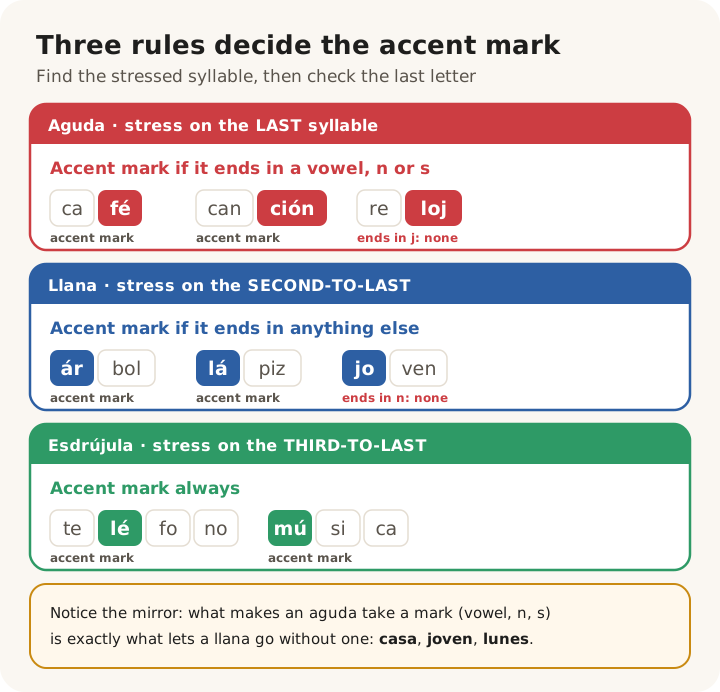
Every Spanish word has one syllable that sounds stronger than the others. Spanish accent marks show where that stress falls, but only when the word breaks the usual pattern. That’s why most words have no mark at all.
| Type | Where the stress falls | Takes an accent mark when | With a mark | Without one |
|---|---|---|---|---|
| aguda | last syllable | it ends in a vowel, n or s | café, canción, autobús | reloj, hablar, ciudad |
| llana | second-to-last | it ends in any other letter | árbol, lápiz, fácil | casa, joven, examen |
| esdrújula | third-to-last | always | teléfono, música, sábado | (none) |
The three rules of Spanish accent marks, from the Real Academia Española. They’re the same in every Spanish-speaking country.
Listen for the strong syllable in bold:
café
coffee
canción
song
reloj
watch, clock
árbol
tree
examen
exam
teléfono
telephone
música
music
Did you catch teléfono? English stresses the first syllable of “telephone.” Spanish stresses lé, and the mark tells you so.
Does it need a mark? Three questions
- Which syllable is strong? Say the word slowly, out loud.
- Third-to-last or earlier? Add the mark and you’re done.
- Last or second-to-last? Look at the final letter and apply the rule from the table.
A few cases on top of the rules:
- The stressed i or u next to a, e or o always takes a mark, to show the two vowels split: día, país.
- Plurals keep the stress in the same place, but the word gains a syllable, so the mark can come or go: canción, canciones; examen, exámenes.
- Pronouns attached to a verb often push it into esdrújula: di + me + lo is dímelo. Adverbs in -mente keep the adjective’s mark: fácilmente.
- One-syllable words don’t take a mark (mes, pan, fue), except the pairs in the next section.
día
day
país
country
canciones
songs
exámenes
exams
dímelo
tell me (it)
fácilmente
easily
A few words change by country: most of Latin America says video (vi-DE-o), and Spain says vídeo (VÍ-de-o). The RAE accepts both.
video
video
vídeo
video
Practice with 30 words and audio in the Spanish accents exercises, where every mark counts.
Accent marks that change the meaning
Some pairs are spelled the same and only the mark tells them apart. The word with the mark is the one you stress when you speak: tú (you) and tu (your), él (he) and el (the), sí (yes) and si (if), té (tea) and te (you), sé (I know) and se (a pronoun). A few more: mí/mi (me, my), dé/de (give, of), más/mas (more, but) and aún/aun (still, even).
Tú tienes tu libro.
You have your book.
Él es mi hermano.
He's my brother.
Para mí, mi casa es la mejor.
For me, my house is the best.
Sí, voy si me invitas.
Yes, I'll go if you invite me.
¿Quieres un té?
Do you want some tea?
No sé si se fue.
I don't know if he left.

Verb forms work the same way. Hablo is “I speak” and habló is “he spoke” (the hablar page has both with audio). Papa is a potato, and papá is your dad. One more you’ll type all the time: está (is) versus esta (this), explained in es vs está.
Qué, cómo, dónde: question words
Qué, quién, cuál, cómo, cuándo, cuánto and dónde take a mark when they ask or exclaim. That holds even inside a sentence with no question mark: No sé dónde vive. When the same word only links two ideas, it goes without.
¿Qué quieres?
What do you want?
Creo que va a llover.
I think it's going to rain.
No sé dónde vive.
I don't know where he lives.
¡Qué bonito!
How pretty!

The same logic gives you ¿por qué? (why?) and porque (because).
Solo and este: no mark since 2010
Older books write sólo and éste. Since the 2010 Ortografía, the RAE says to write solo, este, ese and aquel without a mark. The mark is optional only where a sentence could be read two ways, and even there the RAE recommends leaving it off.
Solo quiero un café.
I just want a coffee.
Este es mi hermano.
This is my brother.
Accent or no accent?
0 of 6___ eres mi mejor amiga.
Me gusta ___ casa.
¿___ hora es?
Este regalo es para ___.
___ quiero un café.
El ___ de mi casa.
The accents exercises also come as a printable sheet with answers, for practice away from the screen.
Frequently asked questions
Do capital letters need accents in Spanish?
Yes. Capitals follow the same rules as lowercase letters: Ángel, ÉXITO. The idea that capitals skip the mark comes from old typewriters, and the RAE says it was never the rule. The only exception is acronyms written all in capitals.
Why don’t all Spanish words have accents?
Because most words already follow the default pattern. A word ending in a vowel, n or s is stressed on the second-to-last syllable, and anything else on the last. The mark only appears when a word breaks that pattern, like café or árbol.
Does solo still have an accent?
No. Since 2010, solo goes without a mark both for “only” and for “alone,” and so do este, ese and aquel.
Can I skip accents when texting?
The rule doesn’t change on a phone. What you lose is meaning. Papa is a potato and papá is your dad. Hablo is “I speak” and habló is “he spoke.” And año is “year,” while ano means anus, so “Feliz ano nuevo” is not the greeting you wanted. Holding the letter takes half a second.
In real chats, plenty of native speakers drop marks when they type fast, and the context usually saves them. As a learner, keep them: they show you where the stress goes.
Does o between numbers take an accent?
Not anymore. Older texts write 3 ó 4 so the o wouldn’t look like a zero. Since 2010, the RAE writes the o without a mark everywhere: 3 o 4.
Is a Spanish accent also the way people sound?
Yes, that’s the other meaning: the accent of Mexico, Spain or Argentina. Written accent marks are the same in all of them. The level test lets you hear four accents.

Spanish teacher · B.A. in Spanish (UnB) · 10+ years teaching
Spanish teacher with a degree in Spanish from the University of Brasília (UnB) and more than 10 years teaching.